

Today, I begin a five-part series on the four Marian dogmas and the fifth Marian doctrine as defined by the Catholic Church. First, though, we should define the terms “doctrine” and “dogma”. “Doctrine” refers to a teaching from the Magisterium pertaining to faith and morals that has been determined to be theologically true and certain. As Catholics, we are called to agree with the teachings and beliefs which the Magisterium has declared to be doctrine. “Dogma”, however, is an elevated truth that God has revealed and is to be believed. This does not make a doctrine any less true than a dogma or that we should not give our assent to doctrine; rather, it simply highlights some things as worthy of understanding at a higher level. theotokos
A doctrine can become a dogma in one of two ways. One way is for an Ecumenical Council to discuss the matter, come to an agreement on elevating the doctrine, and then have it confirmed by the Holy Father. The second way is for the Holy Father to make an “ex cathedra”, or infallible statement on the matter himself. A doctrine may be further developed as more truth is revealed (though it can never change or be reversed). A dogma cannot be changed, as it is the fullness of a truth revealed by God.
The next point of clarification we need to make is regarding why we have Marian doctrines and dogmas in the first place. After all, we worship the Triune God – the Father, the Son, and the Holy Spirit. The truths that the Catholic Church teaches about Mary protect what is true about Jesus. In other words, all Catholic teaching on Mary is a safeguard for authentic Christology. This understanding will become clearer as we go through this series, dissecting each doctrine and dogma. Remember the three sources of authority of the Catholic Church: Scripture, Tradition, and the Magisterium. Look for me to draw from all three sources as we go through the next several weeks. We’ll proceed to the first Marian dogma, beginning with the Magisterium as our source of authority.
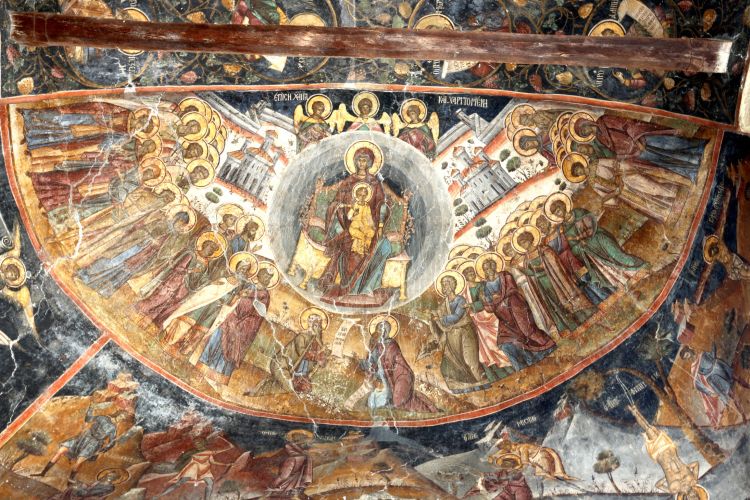
In 431 AD, Mary was declared Theotokos, or “God-bearer” at the Council of Ephesus. This may seem intuitive to us now, but it was not yet clear back then. At the time, a man named Nestorius was teaching that Jesus Christ was actually two separate persons, one human and one divine. Therefore, according to him, Mary could only be the mother of the human person, so Nestorius would only refer to her as Christotokos. This issue is rooted in a huge misunderstanding of the person of Jesus Christ. So the Council, an example of the Magisterium in action, had to first decide the truth regarding Jesus Christ: that he has two natures in one person, one human and one divine. It now becomes more evident that declaring Mary as the Mother of God is extremely important in protecting what is true about Jesus, in that he is indeed the Son of God.
Now, we’ll move to how we back this dogma up with Scripture. In Luke 1, the Angel Gabriel tells Mary she will conceive and bear a son. Then he says, “…therefore the holy one born to you shall be called Son of God.” (Luke 1:32). It is clear by St. Gabriel’s words that Mary will be conceiving the Son of God, who would necessarily be of divine origin. Then, in Galatians 4:4, we hear, “…when the fullness of time had come, God sent forth his Son, born of woman…” Again, God’s Son, born of the woman Mary, would necessarily have to be divine. It is not hard to conclude from Scriptural sources that Mary was, indeed, Theotokos.
Now, we’ll examine sources in Tradition. This is when we look back to how the earliest Christians, who were closer to Jesus in time and space, understood the matter. Before the term Theotokos was coined at the Council of Ephesus in 431, we still see other references to Mary as the mother of God. St. Ignatius of Antioch (c. 107 AD) warns against the separation of the humanity and divinity of Christ who was born of Mary: “Be deaf whenever one speaks to you apart from Jesus Christ who was of the race of David, of Mary, who was really born, ate and drank, was really persecuted under Pontius Pilate…who really rose from the dead.” (Ignatius to the Trallians) In other words, the same Jesus who was born of Mary and acted in His body is the same divine Jesus who rose from the dead. Therefore, the human and divine Jesus were one in the same person, physically born of Mary.
St. Irenaeus (b. 130 AD) fought against the heresy of Docetism, which held that Jesus was not born of Mary but came to earth as an adult, and his body was an illusion. He was also fighting against the Gnostics, who believed Mary did not carry Jesus in a true maternal way but that he simply passed through her. Irenaeus taught that Jesus really and truly became man from the Virgin; otherwise, his saving Passion would be of no importance for us. He stated, “The Son of God was born of the Virgin.” (Against Heresies) From the year 320 AD we have a letter from Alexander, the bishop of Alexandria, which states: “After this we know of the resurrection of the dead, the first-fruits of which was our Lord Jesus Christ, who in very deed, and not merely in appearance, carried a body, of Mary, Mother of God, who at the end of times came to the human race to put away sin, was crucified and died, and yet without any detriment to his divinity, being raised from the dead, taken up into heaven, and seated at the right hand of Majesty.” So, through these few references, we can see how, even though the dogma had not yet been fully developed, an understanding was formed that Mary was indeed Theotokos.
Hopefully, this clearly illustrates how the dogma of Mary as Theotokos was developed through Magisterium, Scripture, and Tradition. However, even more importantly, I hope you begin to see how Marian teaching is less about Mary herself and more about protecting the truth of who her Son is – both human and divine. If we want to get to the root of who he is at the center of our worship, it is essential that we allow his mother to show us who she is.
This week, meditate on the Dogma of Theotokos – that Mary is indeed the mother of God because Jesus is both human and divine. What does that mean for you practically in your life? How does that truth deepen your faith in Jesus and your love for Mary?
To receive articles and reflections like these directly to your inbox, please subscribe.
Do Catholics Worship Mary and the Saints – Latria vs Dulia
Read more about the four Marian dogmas and one doctrine:
Mary as the Immaculate Conception
The Assumption of Mary into Heaven
****An in-depth examination of Mary’s role as Advocate under her spiritual motherhood

The Marian teachings of the Church are grounded in logic, history, Scripture and Tradition. There are some Fundamentalists who claim that the Marian teachings of the Church came out of Middle Age. This line of argument can be easily blown apart with scripture and history.