
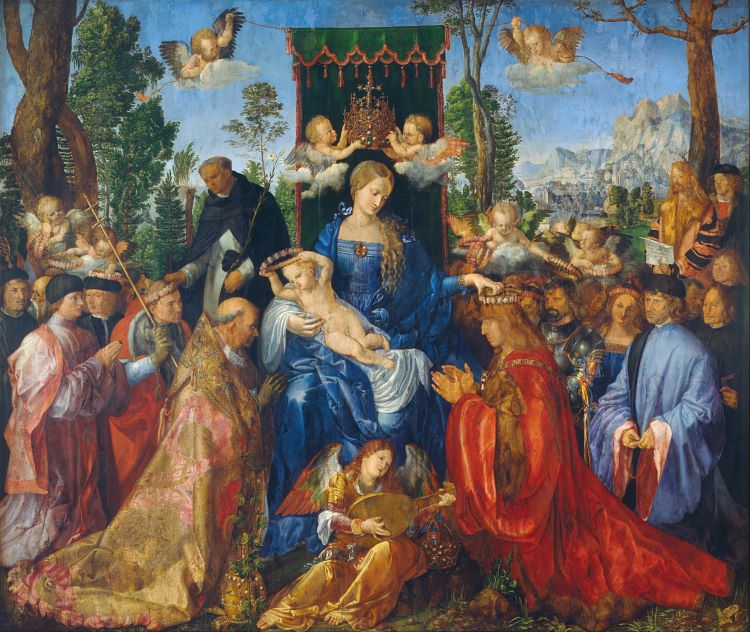
We have now reached the fifth and final week of this Marian series. We covered the four Marian dogmas and will now conclude with the one doctrine the Church teaches regarding our Blessed Mother. If you remember from the first week, doctrine is to be held as true and a matter of our Faith to be believed, but it has not yet been elevated to the level of dogma, which could be for any number of reasons. This doctrine defines Mary’s spiritual motherhood over the Body of Christ through her three-fold role of co-redemptrix, mediatrix, and advocate.
Generally, it makes sense that we should call Mary our spiritual mother. After all, she gave (physical) birth to Jesus, who is the head of the mystical body, the Church. If we are all members of that mystical body, joined to the head, then, by extension, she’s a mother to the entire body. In his encyclical Ad Diem Illum Laetissimum on the Immaculate Conception, Pope Pius X says:
For is not Mary the Mother of Christ? Then she is our Mother also…all we who are united to Christ…are members of His body, of His flesh, and of His bones… issued from the womb of Mary like a body united to its head. Hence, though in a spiritual and mystical fashion, we are all children of Mary, and she is Mother of us all.
Again, notice how this teaching protects the reality of who Jesus is and the cohesive unity between him and his Church.
We also use Scripture to understand that Jesus gave his Mother to all of us before his death. In John 19:25-27, Jesus tells John, “Behold your mother” and tells his Mother to behold her son. This passage should not be simply interpreted to suggest that Jesus is ensuring his Mother is cared for after his death and that John has been assigned the task. After all, it would be doubtful that Jesus, knowing far in advance what his fate would be, would not have made provisions for his Mother long before he was there hanging on the cross. In the final moments before Jesus’ death, it is more likely that he was thinking about all of his people for whom he was dying and how they needed a spiritual mother like Mary. Therefore, the Church interprets that passage to mean that John represents the entire Church and Jesus is giving all of us his Mother as a gift. Also, note that Jesus’ words are not phrased as an invitation. He is not inviting John or us to accept his Mother. “Behold your mother” is not ambiguous; rather, it is a statement of theological fact. Now, we will dive deeper into three specific ways Mary is a spiritual mother to us.
Co-Redemptrix
This title, given to Mary by the Church, means that Mary cooperates with Jesus in his redemptive work and is, therefore, a co-redeemer with him. Before we go further, let’s clarify the language. The Latin prefix “co-“ literally means “with.” It does not mean “equal to.” Think of it this way: A plane is flown by a captain and a co-pilot. The co-pilot is always subordinate to the captain but works with the captain to fly the aircraft. Jesus is the Redeemer, and no one is equal to him, but we all participate and cooperate in his work.
As his Mother, Mary has a unique and special cooperation with Jesus, earning her the title “co-redemptrix.” We see in Genesis 3:15 that God tells Satan that a woman and her offspring will destroy him. He could have left the woman out altogether but left them together as a cooperative unit. We also see Mary’s literal cooperation with the Holy Spirit when she gives her fat in Luke 1:38. Her body is the vehicle by which the Savior enters the world, which only happens because she agrees to cooperate with God’s will. Finally, we see Mary’s cooperation in her suffering, united to her son’s. It is a mother’s instinct to want to protect her child from the horrific suffering that Jesus went through, yet we don’t see Mary pleading with Pontius Pilate or attempting to fight off Roman soldiers. She knows that his redemptive work must take place, and she silently cooperates to the point where she stands at the foot of the cross until the very end. Her suffering is severe but united with Jesus’; it is co-redemptive.
Looking at Tradition, we have many examples of how Mary has been understood as working with her son to bring about salvation. The following are just two of them. St. Irenaeus of Lyons (b. c. 130 AD) said, “Just as Eve having disobeyed, became the cause of death for herself and the entire human race, so Mary being obedient became the cause of salvation for herself and the entire human race.” An Eastern Akathist hymn dedicated to Mary from around 525 AD refers to Mary as “redemption of the tears of Eve.”
Mediatrix of All Graces
To mediate something is to act as a “go-between” for two parties. Christ is the author and source of all grace, and Mary mediated between him and us by agreeing to bring him forth into the world. It is through her intercession that Christ was brought to us in the first place. We would not have that source of grace had she not agreed, so it is, therefore, part of her co-redemptive work to mediate grace to us. We see an example of this at the wedding at Cana (John 2:1-11). Mary places herself between the couple and her son to point out their needs and bring about a miracle. Using the couple as a representation of mankind, Pope John Paul II explains in his encyclical Redemptoris Mater:
Thus there is a mediation: Mary places herself between her Son and mankind in the reality of their wants, needs and sufferings. She puts herself “in the middle,” that is to say she acts as a mediatrix and not as an outsider, but in her position as Mother. She knows that as such she can point out to her Son the needs of mankind, and in fact, she has the right to do so. Her mediation is thus in the nature of intercession: Mary “intercedes” for mankind. (RM #21)
We have abundant resources from the early Church that show this is not a new understanding of Mary’s role in our lives. St. Irenaeus refers to Mary as the “cause of salvation for herself and the entire human race.” She is the cause of our salvation insofar as she brings us Jesus. From the 4th Century, St. Ephrem says, “After the mediator, you (Mary) are the Mediatrix of the whole world.” And from the 8th Century, St. Andrew of Crete refers to her as “Mediatrix of the law and grace.” St. Louis de Monfort (1673-1716) uses the image of an aqueduct through which grace flows from the head to the rest of the body. Another way to think about it is that Mary is the neck of the body, which connects the head to the rest of the members. All the grace that flows from the head passes through her on the way to the rest of the body.
Advocate
Mary’s third role in her spiritual motherhood is that of Advocate. This is an ancient role that finds its precedent in the Old Testament. The kings of the time would often have many wives, so the Queen Mother would be the one to sit at the king’s right, a place of honor. The Queen Mother had three roles: advisor to the king, choosing dynastic succession should the king die, and advocate for the people. 1 Kings 2:19-20 says, “So Bathsheba went to King Solomon to speak to him on behalf of Adonijah. And the king rose to meet her and bowed down to her. Then he sat on his throne and had a seat brought for the king’s Mother, and she sat on his right. Then she said, ‘I have one small request to make of you; do not refuse me.’ And the king said to her, ‘Make your request, my mother, for I will not refuse you.’” The king honors his Mother and does not wish to deny her anything she asks on behalf of the people. Again, we go back to the wedding at Cana, where Mary advocates for the wedding couple and brings their needs to her son, which he does not deny her. While Jesus is God and not dependent on anyone to tell him what someone needs, it was still Jesus’ will for Mary’s role as advocate to be established at that moment. Whenever we need something, it is good practice to bring those needs to Mary and allow her to intercede for us and act as our advocate before her son.
Like all of the other teachings about Mary, many examples from Tradition support her role as Advocate. Let’s look at one profound example here. The most ancient prayer to Mary is called the Sub Tuum Praesidium. Found on a piece of Egyptian papyrus from the third century, it reads, “We fly to thy protection, O holy Mother of God. Despise not our petitions in our necessities, but deliver us always from all dangers, O glorious and blessed Virgin.” Clearly, there was an understanding amongst early Christians that it was efficacious to ask the Queen Mother to intercede and advocate on their behalf.
Whether you have always had a sense of Mary being your spiritual Mother, or if this is a more foreign concept, I hope you are inspired to deepen that relationship. After reviewing all the ways she can be a mother to you, how can you lean into her motherhood and love for you a little more? Jesus gave you a gift out of divine love in giving you his Mother. How might being more receptive to that gift bring you closer to him and his will for your life?
Lenten Rosary/Divine Mercy Chaplet Challenge
An Explanation of the ‘Hail Mary’ Prayer
To receive articles and reflections like these directly to your inbox, please subscribe.

Thanks for sharing this with me and all of us today!