

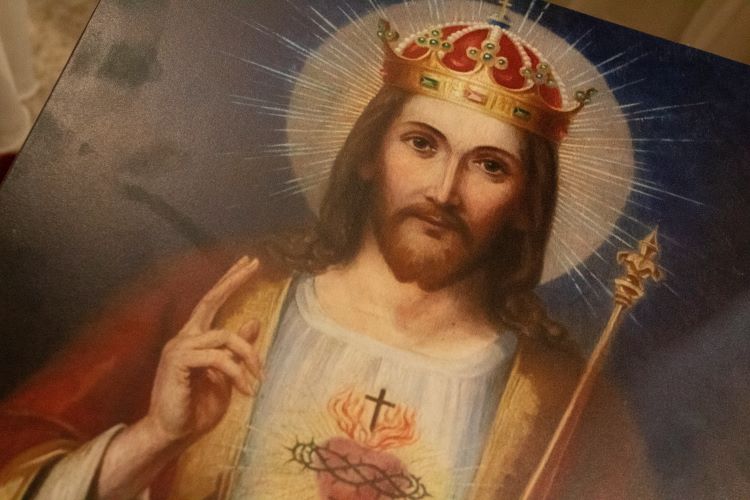
We have spent the last two weeks discussing specific ways we can participate in Jesus Christ’s priestly and prophetic offices. This week, we will conclude our three-part series by examining our role in the kingship of Christ. First, we’ll explore what the Church teaches about what it means for us to be kings. Then we’ll discuss how to put that advice into practice in our everyday lives, based on the guidance provided by Fr. Mark Mary Ames, CFR, in his book, Habits for Holiness: Small Steps for Making Big Spiritual Progress.
Paragraph 36 of Lumen Gentium states that we, the laity, share in Christ’s kingly office by ruling over ourselves, conquering sin, and growing in virtue. By this self-mastery, we exercise a royal freedom and live as witnesses to the Kingdom of God. This interior kingship is the foundation for our mission in the world. We are especially called to bring the spirit of the Gospel into the temporal sphere — family, culture, politics. In doing so, we help to sanctify the world from within and structure it according to God’s will. When things are rightly ordered, justice, peace, and the common good prevail. Our kingship is not about worldly power, but about service, order, virtue, and the renewal of the world in Christ.
As Lumen Gentium correctly points out, we are called to exercise our kingly office in all aspects of the temporal world at large. However, Fr. Ames advises we start by focusing on ourselves. Before we can be kings over anything external to us, we must be kings over our own interior lives. Recall the story of Adam and Eve in the Garden of Eden, before the Fall. Adam was given a significant role in the care and maintenance of God’s Kingdom. He named the animals and was given dominion over them. Tilling the earth, cultivation, and work were all meant to be part of his vocation. Organization, structure, harmony, and responsibility, as embodied in the office of kingship, were all part of God’s original plan for mankind. After sin entered the narrative, we see the opposite of those things — disorganization, lack of structure, disharmony, and irresponsibility — causing problems. When they occur within us, they become obstacles to our holiness, which, in turn, causes more sin, and the vicious cycle continues. Therefore, it only makes sense that we should begin with ourselves by practicing balance, self-mastery, and discipline, so that we can become the masters of our own inner life. Then, we can successfully extend what we have out to the world.
It is a relatively recent development in human history that a sedentary lifestyle is even possible. Computers, motor vehicles, and other technological advancements have helped make our lives easier in some ways, but have also contributed to a decline in physical activity. Our bodies were made for motion, manual labor, and movement. We are a composite of body and spirit, and to be fully healthy, we need to nurture both. Fr. Ames reminds us that, as a first-century Jewish man, Jesus did physical labor all day long. He worked with his hands as a carpenter. When he invited his disciples to follow him, it involved walking for miles on end, hiking up mountains, and going fishing. Discipleship requires some physical exertion. Engaging in physical activity is also an opportunity for discipline. It can be tempting to sit on the couch and watch TV all weekend after a long week of work, so pushing yourself to get up and engage in something physical is a virtuous act, especially when you don’t feel like it. It can be the practice of doing difficult things again and again, so that when you are tested to do something really difficult, you have some experience to draw from. Fr. Ames does not suggest bodybuilding or marathon running, at least not for everyone. He also advises against an unhealthy fixation on bodily health. Seek to find balance between your spiritual and physical life, and be disciplined in your approach to physical activity in a way that works best for you and your body.
The next issue Fr. Ames attends to is rest, or more specifically, sleep. When we don’t get enough sleep, we are tired, and when we are tired, we are more prone to give in to our temptations and sin. Being well-rested is a simple way to help keep our interior house in order. Let’s examine some common reasons for a lack of sleep and explore potential solutions to address this issue. One reason we don’t get enough sleep is that we have overextended ourselves with things to do. Father suggests that to combat this, we cultivate a disposition of contentment. We practice the virtue of temperance when we cut unnecessary stuff from our lives, and we practice the virtue of prudence when we say no to things, even good things, when they do not come at the right time. Practicing these virtues frees us up for the things that Jesus wants for us. Another reason for our lack of sleep is anxiety, which can have many different sources. Before getting into other types of anxiety, Fr. Ames does encourage those who suffer from anxiety that is clinical, or otherwise outside of their control, to seek professional help. However, for the population at large, we needlessly create our own anxiety that God never meant for us. We’ve already addressed being overextended, but what about our expectations? Does what we expect of ourselves line up with what the Lord expects of us? In other words, take note of whether you are trying to please God or please the world to determine if that might be the source of your anxiety. Another source of anxiety might come from being on social media and the 24/7 news cycle. One or both of these bombard us with information, opinions, negativity, comparisons, and divisions. If you put your phone down, close the apps, and turn off the television and radio for a couple of weeks, it’s likely that your anxiety will go down. Finally, Fr. Ames suggests the best remedy for anxiety is to remember your identity as a beloved son or daughter of God the Father, which can only be discovered and fostered by a healthy prayer life. When you’re feeling anxious, find your rest by going to your Father.
Fr. Ames offers a few final practical suggestions for keeping your interior kingdom rightly ordered. Remember that food is fuel that powers you for the journey. He says, “We want to walk a fine line of not overemphasizing the importance of food but not underestimating it either.” He also reminds us of the discipline it takes to eat healthily, which is part of what it means to be a king over our kingdom. Another recommendation is to develop a “holy hobby.” If we don’t find healthy ways to fill our time, Satan will most definitely suggest unhealthy and sinful ways for us to fill it. We must be intentional about our recreational activities. Father also recommends that these activities be done in relationship, not in isolation. This helps to build intimacy, community, and positive memories. Finally, Father Ames recommends you exercise and discipline your mind with study. The study of the Faith is beneficial, but he suggests that as well-rounded individuals, we also study other subjects that interest us, such as history, geography, or music. Learn something new!
Once you are better able to govern your own life with peaceful order, you are better prepared to carry that peaceful order out to the world in the capacity of your share in Christ’s kingly office.
To conclude, here are a few questions presented by Fr. Ames for reflection:
- In general, do I feel like I’m living an integrated life?
- Am I aware of the way exercising helps to form me in discipline and freedom?
- Am I making time to stay rooted in my identity as a beloved child of God?
- Do I have “holy” hobbies and forms of recreation?
Now, with deeper insight into Jesus’ threefold office of priest, prophet and king, and real-world examples of how we can participate in those roles, we can look for opportunities to build up the kingdom of God in our everyday lives.
To receive articles and reflections like these directly to your inbox, please subscribe.

Leave A Comment