

Last week, we discussed the hallmarks of God’s influence on our intellects that help us distinguish the Good Shepherd’s voice from all the distracting and competing voices in our minds. Drawing on the wisdom from Fr. Cliff Ermatinger’s book, Who’s Speaking: Discerning the Good Shepherd’s Voice from that of the Stranger, we will now examine the hallmarks of demonic influence on the intellect, enabling us to more easily identify the thoughts that aim to divert us from our spiritual journey.
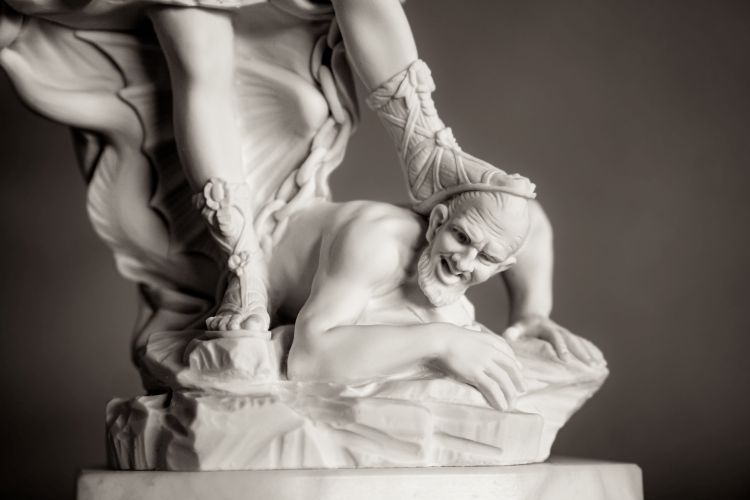
Before getting into how we can distinguish Satan’s voice in our minds, we should understand some fundamental things about him. First, Satan is devoid of any good and is miserable in his existence. His only goal is to convince as many souls as possible to join him by constantly placing temptations to sin before them. It is helpful to think of every temptation you experience as an opportunity to choose happiness with God over misery with Satan. Second, Satan and the demons are far more intelligent than we are. When tempting you, understand that Satan cannot read your mind, but he has studied you personally and intimately for your entire life. He knows your temperament, charisms, weaknesses, emotions, and how you have responded to things in the past. He takes all this information and tempts you through your memories and imagination. Finally, recognize that Satan follows a predictable pattern, which we see right away in the Garden of Eden. His first step is always to make us doubt God’s goodness and separate us from the truth. “Did God really say, ‘You shall not eat from any of the trees in the garden’?” (Gen 3:1). Then he inserts his own lie into our doubt to ensnare us. “You certainly will not die!” (Gen 3:4). Understanding these realities about him, we can now explore how to identify the hallmarks of Satan’s influence on our intellect.
Lies
Above, I mentioned that Satan lies to us, which is a significant hallmark of how he operates. If Satan told us outright that it was him speaking to us, we would reject him outright. So, in every suggestion he makes to us, there is some measure of good or truth to it, with just enough of a twist to make it evil. Remember, “Satan masquerades as an angel of light” (2Cor 11:14). Fr. Ermatinger uses the analogy of someone who is speaking a secondary language that is not their native tongue. He says that you can always tell somehow, whether it is in their accent, vocabulary, or sentence structure. Lies happen to be Satan’s native tongue, so whenever he is speaking some degree of truth to you, something is going to sound off if you are paying attention. The key is staying alert and vigilant, and knowing that Satan is waiting for the moment when you drop your guard.
Frivolous, Impertinent Ideas
This hallmark is designed to divert our focus away from God, particularly in prayer. Do you ever notice that when you’re trying to pray or pay attention in Mass, you suddenly remember what you have to buy at the grocery store or something you have to do later that day? Remember, Satan puts suggestions into your mind because he’s been studying you and knows exactly how you’ll react. Whenever you are distracted or pulled away from prayer by your thoughts, even when they seem innocent, that is Satan taking your attention off of God. Fr. Ermatinger notes that even holy thoughts can be used as a distraction when suggested at inappropriate times. “Ignatius was enthralled by a vision in prayer that frequently came to him, but often at odd hours. It came to him frequently during the night. He later realized that it was the evil one trying to lead him into fatigue.”
Darkness
Last week, we discussed that God allows a soul to experience darkness so that it may continue to seek his light. Satan’s darkness is different and distinct from that type. Satan’s darkness evokes feelings of chaos, despair, fear, or unease. He clouds the natural light of our intellect by appealing to our imagination so as to stir up our passions, senses, and emotions. This separates our intelligence from our wisdom, leading us to do things because we can, not because we ought. Fr. Ermatinger says it’s often not the uneducated who fall into the darkness of the intellect, but the educated, likely because they think they are too smart for such trickery. Then, realizing that they have been fooled, they fall into even deeper darkness.
Obstinacy
This hallmark is relatively simple. It is a refusal or an inflexibility in accepting the authority of Scripture, Tradition, or the Magisterium. “Ultimately, this is a case of disordered attachment to one’s own will over the will of God.” Fr. Ermatinger quotes the ominous words of St. John Cassian, “No other vice leads souls to perdition as does this obstinacy in sin, supporting oneself only on one’s own judgment.” Practically speaking, if there is any Church teaching that you obstinately reject, it’s because Satan’s voice is overpowering the Good Shepherd’s in your intellect.
Indiscretion
We can all agree that virtue is a good thing, but when we take it to excess, it can lead us to pride or a sort of self-satisfaction. An example of this is fasting. Fasting as a form of penance and mortification is good. Still, Satan can appeal to our pride, making us think that if we fast in excess, we have some spiritual superiority, when, in fact, we’re only harming our body, which is not the will of God. This is why it is essential to have a spiritual director before taking on severe mortifications, so their source can be discerned appropriately. Indiscretion is also doing a good thing at the wrong time. “But when you give alms, do not let your left hand know what your right is doing, so that your almsgiving may be secret. And your Father who sees in secret will repay you” (Mat 6:3-4). Or, if a voice is telling you to do a virtuous thing, but it is not proper to your vocation, it is likely a sign that Satan is tempting you to indiscretion.
Vain and Proud Thoughts
We can identify this hallmark by the intention behind our actions. When we are motivated to seek the praise and admiration of others, Satan is appealing to our pride in our intellect. We must be cautious, because it can be just as tempting to stop doing virtuous things to avoid praise and admiration. For example, a good preacher may receive many compliments every Sunday due to his God-given charism moving hearts. Satan can either appeal to his pride, motivating him to seek out more human praise, or he can appeal to his humility, causing him to want to stop preaching and hide his gift so as to avoid human adulation. In either scenario, Satan’s voice wins. Fr. Ermatinger says the answer to this is, “to not seek, or to be bothered by the approval or disapproval of the world, but to seek only God’s glory, and, if praise, His praise.” If we conform our intellect to Christ’s intellect, our thoughts will move us with the right intentions.
Similar to last week’s exercise, think of a problem you are having or a decision you are trying to make. Perhaps you’ve received counsel from various people on the matter, or maybe you have conflicting internal emotions about the situation. Sit quietly in prayer, preferably in the adoration chapel, and immediately dismiss the voices that have the hallmarks of Satan’s influence on your intellect. Then, with your understanding of the hallmarks of the Good Shepherd’s voice, try to find some clarity in the noise.
To receive articles and reflections like these directly to your inbox, please subscribe.




Leave A Comment