
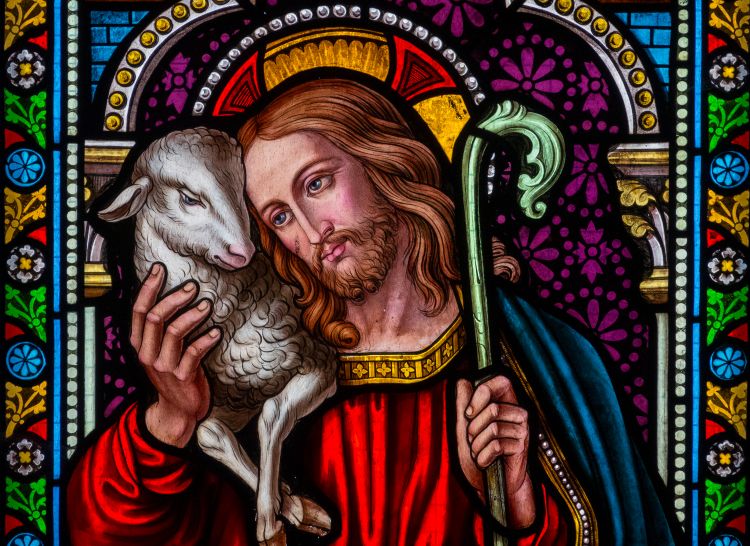
On this Good Shepherd Sunday, our gospel reading offers an image of Jesus for us to contemplate. We, the Church, are a flock of sheep, and Jesus is our Good Shepherd whom we follow with complete trust. Before Jesus came, the Old Testament prefigured the Savior as a shepherd, “The LORD is my shepherd; there is nothing I lack. In green pastures he makes me lie down; to still waters he leads me; he restores my soul” (Ps 23:1-3). This is a rather peaceful description of our expected shepherd and the pasture in which he will watch over us. While the gospel describes Jesus as a good shepherd, his goodness is later intermixed with disturbing imagery such as thieves, robbers, and strangers. If you read just a few lines beyond where the reading in Mass ends, it continues with wolves, a negligent hired hand, and the death of the Shepherd. While Psalm 23 is a beautiful image and likely a small glimpse into heaven, Jesus confronts us with the realities of the world we live in now, where we face adversity and attacks. However, we have a shepherd who will lay down his life for us to save us from harm (cf. Jn 10:11). His Resurrection at Easter proved the Shepherd’s death was not defeat, but victory, opening the way to everlasting life so we can find eventual peace in the pasture of Psalm 23. In a world that often flees from suffering or self-sacrifice, how does the Good Shepherd invite us to the altar where his one sacrifice is made present?
A hired man, who is not a shepherd and whose sheep are not his own, sees a wolf coming and leaves the sheep and runs away, and the wolf catches and scatters them. This is because he works for pay and has no concern for the sheep. I am the good shepherd, and I know mine and mine know me, just as the Father knows me and I know the Father; and I will lay down my life for the sheep. – Jn 10:12-15
A hired man who has no relationship with the sheep cares only about his pay, not the sheep. When danger comes in the form of a wolf, he abandons the sheep, leaving them to whatever fate awaits them. Jesus, on the other hand, is the Good Shepherd and knows his sheep. Notice, too, how Jesus relationship with his sheep is mirrored by the mutual knowledge within the Trinity. Where intimate knowledge, a strong relationship, and love, there is no abandonment like there is with the hired hand.
This is why the Father loves me, because I lay down my life in order to take it up again. No one takes it from me, but I lay it down on my own. – Jn 10:17-18
The Good Shepherd’s sacrifice is voluntary. He places himself between the wolves and his sheep by his own free will because he loves them. This is kenosis – a self-emptying love or a complete giving of self. Jesus loves us so much that he is willing to give himself up entirely, to the point of death, to save us from our sins.
I have power to lay it down, and power to take it up again. – Jn 10:18
Here, Jesus is referring to his coming resurrection and the fulfillment of everlasting life, which, of course, his disciples do not yet understand. Easter cannot come without Good Friday, and everlasting life – access to heaven – cannot come without the Good Shepherd’s sacrifice. Furthermore, the other gifts and graces to come (the Church, Sacraments, etc.) were yet unknown to the disciples, but hindsight tells us it was only through the victory of the Resurrection that they could be established.
Through his sacrifice, the Shepherd not only protects his sheep from the wolves, but he also nourishes them. “The Church…is a sheepfold…nourished and led by Christ himself, the Good Shepherd and Prince of Shepherds, who gave his life for his sheep” (CCC 754). When we celebrate the Eucharist, we re-present (not repeat) the Shepherd’s one sacrifice (cf. CCC1362-72). Thus, the Good Shepherd’s sacrifice is not some distant historical event, but it is made present every day in every Mass. The altar becomes the “pasture” where Christ feeds his sheep with the very body and blood that were laid down on Calvary. The Mass unites us to Christ’s self-gift. Just as he laid down his life freely, the Eucharistic celebration invites us into that same Paschal Mystery. In receiving the Eucharist, we are drawn into his kenosis and nourished by his love.
In our daily lives, we encounter “wolves” – sin, division, anxiety, temptations, and sufferings. Our Good Shepherd doesn’t abandon us. He lays down his life for us at every Mass. At the beginning of this reflection, I asked about how Christ invites us to the altar where he makes present his sacrifice. He invites us, the sheep, to participate in this one unique sacrifice by offering not only our “wolves,” but also everything good we have to offer, and uniting it all to our Shepherd’s sacrifice. “The lives of the faithful, their praise, sufferings, prayer, and work, are united with those of Christ and with his total offering and so acquire a new value. Christ’s sacrifice present on the altar makes it possible for all generations of Christians to be united with his offering” (CCC 1368). When we participate in the Mass this way, we are emptying ourselves (kenosis) back to Jesus in a way that is analogous to the way he emptied himself out of love for us. This is the intimate knowledge to which the Good Shepherd refers when he says, “I know my sheep and they know me.” This reciprocal love, then, mirrors the reciprocal love of the Trinity – a love we all hope to dwell in once in heaven at the end of our earthly life.
As we celebrate this Good Shepherd Sunday, let us respond to the intimate call of our Shepherd who knows us by name and lays down his life for us. As faithful sheep, can we commit to listening even more attentively to his voice, which speaks to us through the noise of this world so we can trustingly follow him through the dark valleys and green pastures? We are blessed that God did not entrust his flock to a hired hand who would abandon us when the wolves came. Spend time in prayer, giving thanks for the Good Shepherd who has laid his life down for his sheep. The next time you are at Mass, contemplate the Eucharistic sacrifice in the context of the sacrifice of the Good Shepherd and offer your sacrifices back to him, sharing in his Trinitarian self-giving love.
To receive articles and reflections like these directly to your inbox, please subscribe.


Leave A Comment