
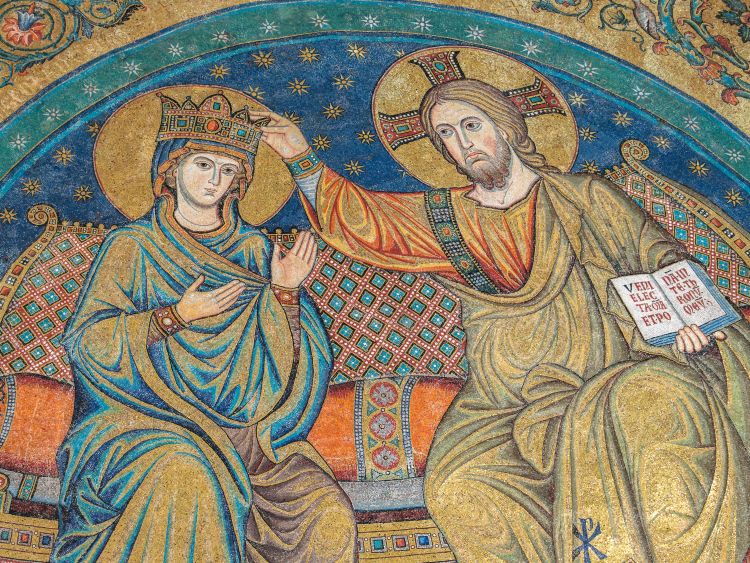
We have reached the midway point of a five-part series in which we are gaining a deeper understanding of the Salve Regina. Sometimes, we become so accustomed to saying certain prayers that we don’t stop to think about what we really mean by our words. The hymn is a prayer to Mary, imploring her under various titles and asking for her intercession. We will now move on to the next two stanzas of the hymn to better understand what we are praying for.
To Thee do we Sigh, Mourning and Weeping in this Valley of Tears
While life overall is a beautiful gift, filled with many joys and blessings, we also face much sin and suffering. In these times of difficulty and trial, we turn to others for help. On earth, we look to our friends and family for support or a shoulder to cry on. Perhaps more importantly, we seek intercessory prayer. Scripture encourages intercessory prayer. St. Stephen prays for his persecutors as they are stoning him to death (cf. Acts 7:59-60), St. Paul prays for others and asks for prayers from others repeatedly throughout his letters, and St. James tells us that we ought to pray for one another (cf. James 5:16). However, Scripture also tells us that not only those living on earth can pray for us, but souls that have already gone to heaven can pray for us as well. In the Old Testament, Judas Maccabeus has a vision of the prophet Jeremiah praying for Jerusalem after his death (cf. 2Mac 15:13-16). Knowing that his death is imminent, St. Peter promises his disciples that he will be mindful of them after he is gone (cf. 2 Pet 1:15), and in heaven, the ancients present the prayers of the saints to God (cf. Rev 5:8). Therefore, when we sigh to Mary in our mourning and weeping, we are turning to her for the comfort her intercessory prayer provides for us.
When we turn to the Blessed Mother in our sorrow, we do not obscure or overlook the glory of the Son. Rather, by honoring his mother, we magnify his glory. How much more does Jesus love Mary than we do? At the foot of the cross, he gave us the gift of his mother, and by accepting that gift with a fraction of the love he has, we honor him. When we ask Mary for help, it is not because we distrust God. It is because she looks at us with a warmth and tenderness that only a mother can.
Mary’s intercession is necessary for our salvation – not in an absolute way, but in a moral way. Of course, God is the source of every good, but the graces he provides to us pass through her hands to us by her intercession. St. Bernard of Clairvaux refers to her as an “aqueduct” or the “neck” that connects the Lord (head) to his mystical body. God would not have become man without Mary’s consent in the first place, so it is fitting that she continues to deliver his grace to us. We would not and could not know Jesus if Mary had not cooperated in bringing him to us. “[T]hey saw the child with Mary his mother” (Mat 2:11). To find Jesus, we must go to Mary. Even Elizabeth, in greeting Mary, knowing that the Lord was in her womb, deemed herself unworthy to be in his mother’s presence (cf Lk 1:43). So, when we sigh to Mary to help or save us, we are not asking her to do what only God can do. Instead, we are recognizing her great favor with God and asking for her intercession as a prisoner would ask a favored member of the court to go to the king and ask for his or her life to be spared.
O, Gracious Advocate
When any earthly mother gives birth, she has great authority over her child. She never becomes his subject, even when he reaches adulthood. He is always commanded to honor her. Jesus, however, is both human and divine. In his divinity, he is Lord of all, including Mary. However, it remains true that for the time he lived on this earth, in his humanity, he humbled himself and subjected himself to her. “He went down with them and came to Nazareth and was obedient to them” (Lk 2:51). In other words, God subjected his will to his mother’s will and the lamb followed her. Now, Mary cannot command him in the same way in heaven, but her prayers are still those of a mother. In other words, she has great privilege, greater than any other person in heaven. It pleases Jesus to honor his mother by granting her requests because she honored him. Because of this, Mary is the best advocate for us.
The Blessed Mother’s first thought is to always seek the glory of God. Her second thought is to always comfort the miserable or, put differently, advocate for us in our every need. Consider how she did both at the wedding feast in Cana. Mary saw that the couple was out of wine which would cause them embarrassment and knew that her Son could help by way of a miracle. She went to her Son and told him they had no wine. Note, she did not ask. Jesus responds to his mother by telling her that his time has not yet come. Rather than responding to Jesus, Mary turns directly to the servants and says, “Do whatever he tells you” (Jn 2:5). In other words, she acts as though her favor has already been granted despite his previous words. This indicates that Mary knew and understood her privilege with her Son and that he would honor her wishes. Finally, Jesus turns water into the best wine. This “manifested his glory. And his disciples believed in him” (Jn 2:11). This story is profoundly significant because it illustrates both the Blessed Mother’s relationship with the people and her relationship with her Son. These interactions continue to happen now as she advocates on our behalf for whatever we need.
The final thing to note about Mary, our advocate, is that she desires our salvation. In fact, she desires our salvation more than we do, because she is our loving mother. Therefore, she wants us to turn to her for help in achieving salvation because what would be the purpose of her privilege and power otherwise? Do not doubt Mary’s compassion for you in your sins and brokenness. No matter how bad you might think it is, Mary sees past it all. When you read through the Gospels, there are moments when Jesus expresses severity in his words, but Mary never does. She is a soft mediator.
In these two stanzas, we’ve covered that there are difficult times in life. We may suffer from illness or injustice. We may also struggle with sin, or even serious temptations to mortal sin. We can turn our sighs into prayers to our Blessed Mother, asking for her intercession. She wants to comfort and reassure us, especially of God’s mercy and love. In our struggles with sin, she wants to help us with strength and perseverance so that we may obtain salvation. This week, read the wedding feast at Cana several times, slowly. Meditate on each part of the story. Imagine yourself in the couple’s place and consider how unfortunate it would be if we didn’t have such a powerful advocate. Ask Mary to show you the areas of your life where she can provide you with more assistance.
To receive articles and reflections like these directly to your inbox, please subscribe.
If you like what you’re reading and wish to donate to help offset ongoing web maintenance, research, and development expenses for Catholic Heart Ablaze, please click here.

Leave A Comment