
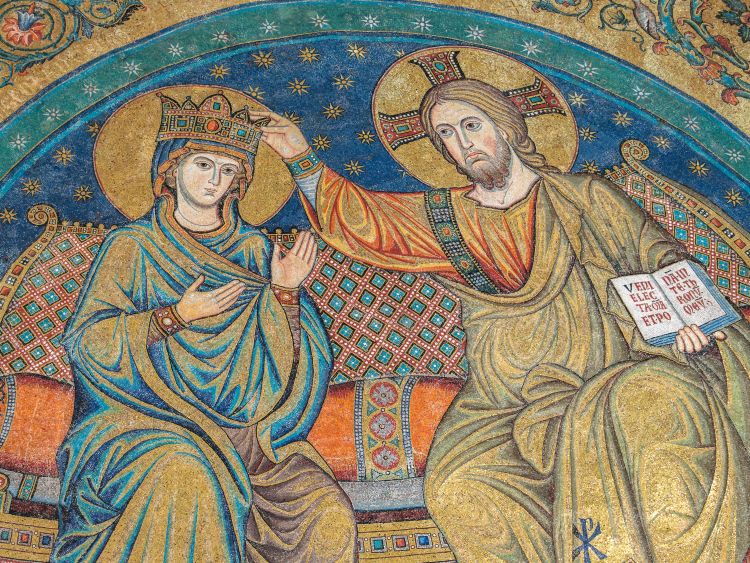
Last week, we began a five-part series in which we are dissecting the text of the Salve Regina to gain a deeper understanding of the hymn. We covered Mary’s roles as Holy Queen, Mother of Mercy, Our Life, and Our Sweetness. We will now move on to the next set of words we pray in the Salve Regina.
Our Hope
St. Thomas Aquinas explains that we can put our hope in someone in one of two ways: as 1) a principal cause or as 2) a mediate cause (Summa Theologica, II-II, q. 17, a. 4). The principal and final cause of our hope is God alone, and we cannot put any ultimate hope for our salvation into any human being, Mary included. However, it is permissible to have hope in another human being as an instrumental agent, or as a mediate cause through whom God helps us obtain goods ordered to happiness. This would include placing our hope in a doctor for healing, in a friend for support, or in asking friends on earth or saints in heaven for intercessory prayers. A mediator may intercede on behalf of the people and ask a king to grant them a favor. If that favor is granted, it comes primarily from the king, as he is the principal cause of the people’s hope. However, the favor comes through the person the king sends to grant it, and through whom it was mediated. This mediator can also be considered the people’s hope as a mediating cause. Jesus is our hope as a principal cause. Our salvation can only be found in him, and of course, we can always go to him for anything we need, which I’m sure most of us do. However, Mary, as the Queen Mother, is a very powerful intercessor and someone we can appeal to as a mediate cause of our hope.
Mary is also the hope of sinners. In Genesis, God created two great ligts: one to rule the day and a lesser one to rule the night. In an analogous way, Jesus Christ is the greater light to rule the just, and Mary is the lesser light to rule the sinners. Whoever is in the night of mortal sin has lost the light of Christ and the grace of God, and he should look to the light of the moon for guidance. Here, you may also call to mind Mary’s title of “Star of the Sea.” When you are lost in the dark, stormy seas of sin, look for the star to help lead you toward salvation. If you are in the state of mortal sin and are cut off from God’s grace, please know that you are never cut off from Mary’s assistance. She does not deny her help and protection to anyone, so continue to call upon her until you find your way back into the light. Equally, staying close to Mary is a very good way to prevent oneself from falling into mortal sin.
One final way to think of Mary as our hope is to consider her a hospital for the sick (sinners). In the Acts of the Apostles, we read that some of the Apostles were given such power that even their shadows healed the sick who were brought out and laid in the streets (Acts 5:15-16). Mary is the living tabernacle that carried our Lord Jesus Christ in her womb and the handmaid of the Lord. If the Apostles’ shadows have that much healing power, how much more power must Mary have to help heal our souls and lead us to heaven?
To Thee do We Cry, Poor Banished Children of Eve
With Original Sin, all of humanity was condemned to the same penalty as Eve, which is exile. In our exile, we wander about in a valley of tears filled with afflictions of both body and soul because of sin. In bearing Jesus, the fruit of her womb, Mary participated in undoing the sin of Eve. The Church continuously cries out to Mary in a multitude of ways. She is honored with specific feast days as well as one day per week (Saturday), the Angelus prayer three times per day, novenas, prayers, churches named in her honor, images and icons, the rosary, and many more examples. Mary does not want these things for her own sake or honor, but because they increase our devotion and confidence, and trust in her. In other words, these ways of crying to Mary are for our good, not hers.
Recall the wedding feast at Cana. Mary noticed the couple was out of wine and interceded with her Son on their behalf. Note that the couple did not go to her first. Mary does anticipate our needs and helps us when we do not ask. However, she helps us so much more when we ask because she is eager to do so. When Mary went to visit Elizabeth, she went “with haste,” which was not said of her return home (Lk 1:39). When Mary comes to someone’s aid, she does not run; she flies with the love of God in her heart. Remember, when we discussed Mary as Queen, we established that she has no power to judge or chastise. All of that power lies with Jesus as King. So, when we cry to Mary, she comes with haste, bringing only mercy, tenderness, love, and the power to intercede on our behalf.
In the Garden of Eden, Eve was tempted by the serpent and ultimately failed. Mary, on the other hand, crushes Satan’s head. “I will put enmity between you and the woman, and between your offspring and her offspring; he shall bruise your head and you shall bruise his heel” (Gen 3:15). Further, while the Levites wandered in the wilderness, they would lift the Ark of the Covenant and Moses would say, “Arise, O Lord, and let your enemies be scattered, and let those who hate you flee before you” (Num 10:35). Mary is the Ark of the New Covenant and when Jesus raised her to the dignity of Queen all earthly and spiritual enemies became subject to her. For these reasons, when you find yourself tempted, call upon Mary for help because even the demons are subject to her.
Reflect on the ways in which Mary is a mediate cause of your hope and how you cry out to her in your times of need. Recall specific times when Mary answered your cries, allow those memories to increase your confidence in her and thank her for those moments. If you are someone who struggles with asking Mary for help, consider taking up a small or simple devotion to her (e.g., a daily Hail Mary or Angelus), knowing that she wants to fly to your aid with haste, filled with God’s love.
To receive articles and reflections like these directly to your inbox, please subscribe.
If you like what you’re reading and wish to donate to help offset ongoing web maintenance, research, and development expenses for Catholic Heart Ablaze, please click here.

Leave A Comment