
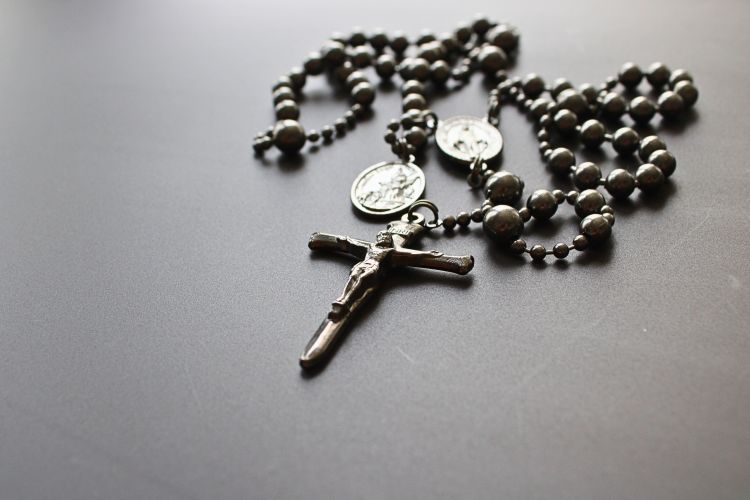
The month of October is dedicated to the Holy Rosary of the Blessed Virgin Mary, with the feast of Our Lady of the Rosary falling on October 7th. Following the Christian naval victory over the Ottoman fleet at the Battle of Lepanto on October7, 1571 – a victory attributed to Mary’s intercession amid widespread prayer of the Rosary – Pope Saint Pius V Established the feast of Our Lady of Victory. In 1573, Pope Gregory XIII changed its title to the Feast of Our Lady of the Rosary. Pope Clement XI then extended the celebration to the universal Church in 1716, and Pope Saint Pius X fixed its date as October 7 in 1913. The entire month of October was dedicated to the Holy Rosary by Pope Leo XIII in he 1883 encyclica Supremi Apostolatus Officio (The Supreme Apostolic Office).
Pope Leo XIII (reigned 1878–1903) is affectionately known as the “Rosary Pope” for his personal devotion and strong promotion of the prayer to the faithful. He believed the Rosary was a spiritual remedy for the troubles of the modern world. He also wrote many encyclicals on the Holy Rosary during his pontificate, promoting peace and protecting the Church. None of these encyclicals is exceptionally long and they are all available on the Vatican website. I encourage you to look them up to inspire you, as they are all just as relevant today as they were over 100 years ago.
Today, we will look at Leo’s encyclical Magnae Dei Matris (Of the Great Mother of God): On the Rosary, promulgated in September of 1892. Faced with growing secularism, moral confusion, and attacks against the Church, this encyclical called for a renewed devotion to Jesus Christ through his Blessed Mother, especially by praying the Holy Rosary. This call still resonates with us today, as the pope’s concerns about society still ring true over 130 years later.
Leo begins the encyclical with a personal reflection. From childhood, his love for the Blessed Virgin Mary has been a fundamental part of his spiritual life. He recalls with gratitude the countless favors received through her maternal care, especially amid the trials of his long pontificate. When elected pope, a responsibility he called an “enormous burden,” he immediately turned to the Blessed Virgin, confident that her intercession would supply what his human strength could not (MDM #3). His confidence in her care was never shaken. Encouraged by his experience, he invites the whole Church to intensify its devotion to Mary, particularly through the Rosary during October.
The pope then outlines the dangers facing the Church and society. He describes a world in which Christian faith is being eroded by ignorance, error, and vice. Public institutions often ignore or even mock the name of God. The press and public dialogue increasingly grow hostile to Christ and his Church. He also notes a growing indifference among many baptized Catholics. He laments that all these factors add to the afflictions of the world at large. However, these social problems are not simply political or cultural. They are fundamentally spiritual. When people abandon God, disorder follows in both their personal lives and in society.
The remedy for all these ills is “devout and persevering prayer” (MDM #7). However, prayer must be accompanied by the practice of a virtuous Christian life. These two ingredients – prayer and virtue – “are best attained through the devotion of the Rosary of Mary” (MDM #7). Leo goes on to recount the historical origin of the devotion. When the Albigensian heresy threatened Christian society in the thirteenth century, the Church responded not primarily with “troops and arms,” but with the Rosary (MDM #8). Through this prayer, the Church triumphed. Further, in every subsequent trial, the Rosary has proven to be the most formidable weapon. For this reason, he urges the faithful to fulfill their duty by uniting their prayers and asking for the Blessed Mother’s intercession with the same devotion as their ancestors, so that they might experience the same power of the Rosary.
One of the most beautiful sections of Magnae Dei Matris explains why Catholics confidently seek Mary’s intercession. Christ became our brother by taking on our human nature. Through his saving work, he also gave us the privilege of calling God our Father. Similarly, Christ gives us Mary as our spiritual Mother. However, Mary’s motherhood is not simply symbolic. Because of her intimate union with Christ, she has genuine maternal care for all of her children. Like any loving mother, she knows her children’s needs, struggles, temptations, and sufferings. She desires to console, strengthen, and guide them toward eternal life. Therefore, we can approach her with confidence, invoking her through the prayer she herself has indicated as most acceptable and rest securely under her protection.
Pope Leo further explains why the Rosary is such a powerful spiritual practice. He notes that many dangers arise from ignorance of the faith. The Rosary combats this ignorance by continually placing the central mysteries of salvation before our eyes. The Rosary is a form of meditation that serves as catechesis. The joyful mysteries recall the Incarnation and the hidden life of the Holy Family; the sorrowful mysteries remind us of the price of our redemption; the glorious mysteries call to mind the glories of the Resurrection, the Ascension, the coming of the Holy Spirit, the Assumption of Mary, and the eternal glory of the saints. Praying the Rosary simultaneously teaches doctrine while encouraging devotion. So long as the Rosary is honored by the faithful in “places, families, and nations,” the loss of faith through ignorance is nothing to be feared (MDM #18).
Beyond catechesis, devotion to the Holy Rosary encourages virtuous living. Leo XIII reminds us, “faith without works is dead” (MDM #19). As believers meditate on Jesus’ humility, obedience, patience, mercy, compassion, and sacrificial love, they are invited to imitate him. Likewise, the Rosary presents the virtues of Mary to us, which we are also invited to imitate. Mary was born of royal lineage, yet lived in poverty and obscurity, responding to the angel’s message with profound humility, declaring herself the handmaid of the Lord. She shared every joy and sorrow of her son, culminating in her presence at the foot of the cross. Mary exemplifies perfect conformity to God’s will so we are encouraged to imitate her and are confident she will help us.
Leo then calls for the Rosary to be “devoutly recited and meditated upon” (MDM #29) He especially recommends the devotion to the members of the Confraternity of the Holy Family, which he had recently approved, reminding us of our call to imitate the Holy Family in our own families. The joyful mysteries, ending with the Finding of Jesus in the Temple and the return to Nazareth, are particularly suited to those who seek to model their domestic life on the Holy Family. By devout recitation and meditation, families can grow in the same spirit of obedience, mutual love, and union with God that marked the home of Jesus, Mary, and Joseph.
Magnae Dei Matris concludes with a message of hope. While the pope clearly recognizes the problems facing the Church and society, he does not despair. He places his confidence in God’s providence and Mary’s intercession. We ought to follow Pope Leo XIII’s lead. Rather than responding to hostility with anxiety, we are called to greater holiness. Rather than becoming discouraged by cultural decline, we are invited to become more faithful disciples. We ought to take up the Rosary with devotion, meditate on the mysteries of salvation, and allow the example of Jesus and Mary to shape our daily conduct. In praying the Rosary daily, the mysteries will transform both our hearts and lives, and ultimately, the Church and the world. Consider accepting Pope Leo’s invitation to pray your rosary devoutly every day in October for the conversion of the world.
To receive articles and reflections like these directly to your inbox, please subscribe.
If you like what you’re reading and wish to donate to help offset ongoing web maintenance, research, and development expenses for Catholic Heart Ablaze, please click here.

Leave A Comment