
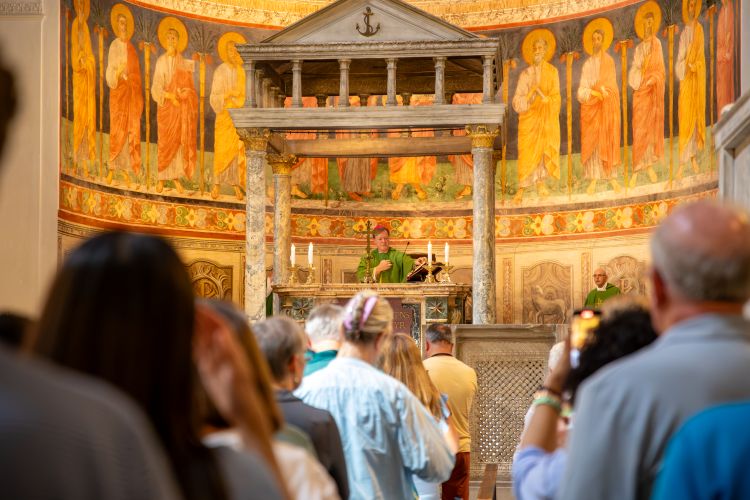
For all baptized Catholics, Sunday Mass is not optional, but an obligation. Sunday is the day on which Jesus Christ rose from the dead and is therefore worthy of weekly celebration. Since the earliest days of the Church, beginning with the Apostles, Christians gathered on the first day of the week to celebrate the Resurrection and the Eucharist. These gatherings very quickly became a solemn obligation of faith. The requirement is rooted in the third commandment to “keep holy the Sabbath” by remembering Christ’s Passion, Resurrection, and glory and giving God the thanks, praise, and worship he is due. While the obligation to attend Sunday Mass is serious, it should not be perceived as burdensome and legalistic. We ought to approach Mass with love for God and view it as a gift. We are privileged to freely accept God’s invitation to gather where Christ encounters the faithful, nourishes us with his body, and unites us in faith and charity.
The importance of Sunday begins with the Resurrection. Jesus rose from the dead on the first day of the week (cf. Mt 28:1, Mk 16:2, Jn 20:1). The risen Christ appeared to the disciples that day and again eight days later (Jn 20:19,26). The Second Vatican Council teaches that the tradition of weekly Sunday worship began with the Apostles and is consequently the “original feast day” and the foundation of the liturgical year (Sacrosanctum Concilium #106). Sunday Mass also protects the Christian meaning of Sunday itself. The Church teaches that Sunday should be a day of worship, joy, rest, and renewal in imitation of God’s rest after Creation.
The Church requires Catholics who are bound by the law to attend Mass on Sundays and holy days of obligation. The Code of Canon Law states, “On Sundays and other holy days of obligation the faithful are bound to “participate in the Mass” (Can. 1247). The Catechism of the Catholic Church also explains, “The precept of participating in the Mass is satisfied by assistance at a Mass which is celebrated…on the holy day or on the evening of the preceding day” (CCC #2180). In this context, “assistance” does not necessarily mean performing a particular role such as reading, serving, singing, or distributing the Eucharist. It means being present at and participating in the celebration of the Eucharist, not merely attending as a silent observer.
The obligation is considered serious because “The Sunday Eucharist is the foundation and confirmation of all Christian practice” (CCC #1281). Catholics are therefore obliged to participate unless there is a serious reason – such as illness, the care of a dependent, or dangerous travel conditions – or have received a dispensation from their pastor (CCC #2181). “Those who deliberately fail in this obligation commit a grave sin” (CCC #1281). This statement is important to understand. There are three conditions to a mortal sin: grave matter (a serious violation of God’s law or the Ten Commandments), full knowledge (knowing that the act is sinful and wrong), and deliberate consent (freely choosing to do it anyway) (CCC 1#857). Deliberately choosing not to attend Sunday Mass or holy days of obligation without a serious reason can therefore constitute a mortal sin and endanger one’s soul. If you have knowingly and freely made such a choice, please receive the Sacrament of Reconciliation before receiving the Eucharist.
Recurring situations can raise questions. Some professions require working on Sundays, preventing Mass attendance. Other examples may include disability or caregiving that prevents one from leaving home.
When a serious reason makes attendance impossible, the obligation does not bind; when the situation is uncertain or will recur, the person should speak with his or her pastor for guidance and, when appropriate, a dispensation. Unavoidable situations should not cause anyone unnecessary anxiety.
It is worth noting what does not constitute a “serious reason” for missing Sunday Mass. A desire to sleep in, attend a sporting event, attending social engagements, being on vacation, or a general feeling that Mass is not interesting do not excuse the obligation. Attending Mass does not depend on our worldly recreation or subjective feelings about the liturgy. There is a key distinction between inability and inconvenience. Remember, the Mass is a re-presentation of Christ’s sacrifice, and our presence is an act of obedience, worship, and communion with the whole Church.
At Sunday Mass, the Eucharist strengthens Catholics’ communion with God and communion with one another. At Mass, Catholics join the whole Church – those gathered on earth, the faithful departed still being purified in purgatory, and the saints in heaven – in worship of the Father through the Son in the unity of the Holy Spirit. “Participation in the communal celebration of the Sunday Eucharist is a testimony of belonging and of being faithful to Christ and to his Church” (CCC #2182). By worshipping together, Catholics publicly testify that they belong to Christ and his Church. Those assembled profess a common faith in the Nicene Creed, bear witness to their hope of salvation, and strengthen one another in the Holy Spirit.
The Church understands that sometimes attending a Sunday Mass may be impossible and not the result of a deliberate choice. If a person is unable to attend Sunday Mass “because of a lack of a sacred minister or other grave cause,” the faithful are encouraged to commemorate the day in some other intentional and meaningful way (CCC #1283). For example, where there may be a shortage of priests, participation in a Liturgy of the Word, when available, is recommended. If no other option is possible, one ought to spend an appropriate amount of time in prayer individually or with family.
The Code of Canon Law states that the obligation is fulfilled by attending Mass on the holy day itself or “in the evening of the preceding day” (Can. 1248). So, a Saturday evening Mass can fulfill the Sunday obligation. The Church does not specify a precise time to define “evening.” Pastorally, 4:00 pm is a common understanding. If one attends a Mass earlier on Saturday, such as at a wedding at 2:00 pm, it does not fulfill the obligation. It is best to follow the Saturday Mass schedule set by the parish and the diocese.
After reviewing all these rules regarding Mass attendance, it may seem as though following rules themselves is the point. However, the Church always has our best interests at heart, and by implementing rules, she helps keep us on the path to eternal happiness in heaven. I stated earlier that attending Mass is a gift. Setting apart one day a week helps us stay grounded in God and be nourished by his Word and the Eucharist. Our human nature inclines us to drift away, so the Sunday obligation protects us from ourselves. When we honor Sunday with a disposition of gratitude, Mass becomes a joyful opportunity instead of a burdensome obligation. Rather than asking, “Do I have to go to Mass?” the better question is, “Why would I willingly deprive myself of the weekly encounter with the risen Christ and the Blessed Sacrament that he and his Church have given me?”
To receive articles and reflections like these directly to your inbox, please subscribe.
If you like what you’re reading and wish to donate to help offset ongoing web maintenance, research, and development expenses for Catholic Heart Ablaze, please click here.


Leave A Comment