
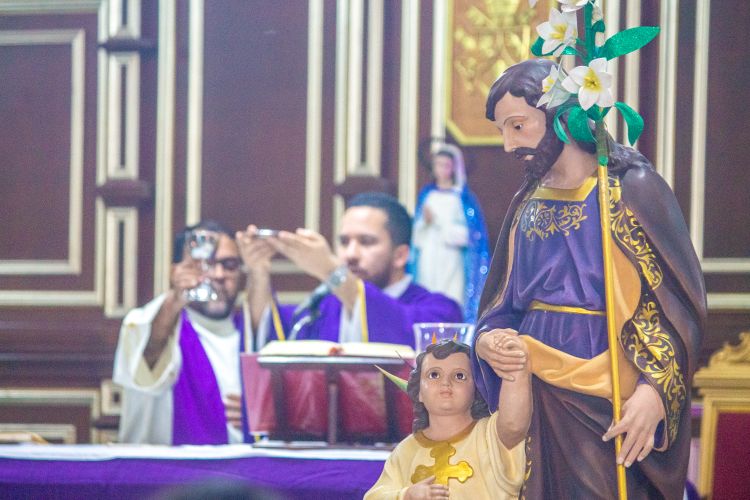
One of the Church’s most beloved saints is St. Joseph. He is honored and revered for his role as the head of the Holy Family and guardian of Jesus. The litany of St. Joseph asks for his intercession under his various titles such as Protector of the Holy Church, Light of Patriarchs, and Guardian of the Redeemer. In his book, Saint Joseph: The Man Closest to Christ, Fr. Sebastian Walshe, O. Praem., asserts that St. Joseph is also the Guardian and Provider of the Eucharist. His premise is that because St. Joseph was entrusted with the care of Christ’s physical body on earth, he continues to exercise unique guardianship and care over Christ’s sacramental body in the Eucharist from heaven. Fr. Walshe reaches this conclusion through two foundations – typology and theology, which I will explain here.
Typology
To understand how St. Joseph has been entrusted with the Eucharist, we must first recall the story of Joseph the Patriarch. In Genesis 41, Joseph interprets Pharaoh’s dreams, foreseeing seven years of plenty followed by seven years of famine. As a result, Pharaoh elevates Joseph to second-in-command of Egypt. This powerful position gave him the authority to collect and store grain during the years of plenty and to ration and distribute it in the years of famine. When famine came, Joseph opened the storehouses and distributed grain to the Egyptians. However, the famine spread far beyond Egypt and “all the earth came to Egypt to Joseph to buy grain” (Gen 41:57, emphasis mine).
Typology is “the study of persons, places, events, and institutions in the Bible that foreshadow later and greater realities made known by God in history…[God] who providentially shapes and determines the course of human events, infuses those events with a prophetic and theological significance” (Catholic Bible Dictionary). By applying typology to the story of Joseph the Patriarch, we can make connections with St. Joseph. Grain is used to make bread, and the Eucharist is the Bread of Life. Joseph the Patriarch’s universal authority to ration and distribute grain to “all the earth” in order protect and guard the well-being of the people prefigures St. Joseph’s universal protection and guardianship over the Church and, by extension, over the Eucharist. Interestingly, Fr. Walshe calls to mind the pandemic of 2020 when we experienced our own famine and lost our access to the Bread of Life. In Genesis, the people sold their cattle, land, and freedom to Pharaoh to obtain grain, but “only the land of the priests he did not buy” (Gen 47:15-22). Fr. Walshe notes that during the famine of 2020, only priests were guaranteed access to the Eucharist because of their ability to celebrate Mass and consecrate the Eucharist. He states, “In times of Eucharistic famine, it seems as if St. Joseph will provide the Eucharist to those who give their property, bodies, and even freedom to God through religious profession,” namely, our priests (SJ pg. 89).
Additionally, the name of the town in which Jesus was born – Bethlehem – means “house of bread.” Bethlehem was a fitting place for St. Joseph to begin exercising guardianship over the infant Jesus – a place associated with bread. These are not forced parallels. Typology is a divinely intended pattern that illuminates the New Testament reality.
Theology
Fr. Walshe bases his theological premise for St. Joseph’s care over the Eucharist on a syllogism. St. Joseph cared for Christ’s physical body, which the angel commands when Joseph takes the Child and his mother and flees to Egypt (cf. Mt 2:13-14). In other words, the entire well-being of the Child is placed under Joseph’s care. Continuing the syllogism, one who has care over Christ’s physical body ought to also have care over his sacramental body. Therefore, St. Joseph has care over the Most Holy Eucharist, Christ’s sacramental body.
Recognizing the possible difficulty in understanding why Joseph has care over the Eucharist because of the differences between Christ’s physical body and his sacramental body, Fr. Walshe provides further clarification. The sacramental body is the same body Joseph cared for, but now hidden under the appearance of bread and wine. Even while the Infant Jesus was wrapped in swaddling clothes and largely hidden from view, Joseph still cared for that body. It’s the same reason the Church recognizes Mary as Mother of the Eucharist, since the body Christ received from Mary at his Incarnation is the same body that is truly present in the Eucharist
Continuing with another principle, Fr. Walshe explains that when one cares for the whole, that care includes all that is contained in it. For example, if you care for a family, you care for each member of that family. Additionally, a mother or father exercises care for a child whether that child is at home or away from home. “Jesus’s sacramental body is simply an extension of his natural body now present in a different manner. Therefore, caring for Jesus’s body includes caring for that same body under its sacramental form” (SJ pg. 92). St. Thomas Aquinas uses a similar analogy linking the Eucharist to the mystical Body of Christ. He explains that grace flows to all the members of the mystical Body of Christ from its head (cf. SJ pg. 92-93). Christ, the Head of the Church is truly present in the Eucharist (CCC 92-795, 1374). St. Joseph had universal guardianship over the physical body of Jesus and currently has guardianship over the mystical Body of Christ – the Church – as recognized in his litany. This gives him unique guardianship over the Eucharist.
We see support for Joseph’s role as guardian and provider of the Eucharist in the parable of the faithful and wise servant (Mt 24:42-47). In the parable, the master gives the faithful and wise servant authority over his household “to give them food at the proper time.” St. Joseph was the only servant placed over the Master’s actual household – the Holy Family – and provided Jesus and Mary with their daily sustenance. The household of God is the Church, and the primary food is the Holy Eucharist. Therefore, St. Joseph is entrusted with providing the spiritual sustenance of the whole Church. The Church further confirms this in the liturgy with the Votive Mass of St. Joseph. The Preface of the Mass – the opening prayer of the Eucharistic prayer – applies this parable to Joseph nearly verbatim:
For this just man was given by you
as spouse to the Virgin Mother of God
and set as a wise and faithful servant
in charge of your household
to watch like a father over your Only Begotten Son,
who was conceived by the overshadowing of the Holy Spirit,
our Lord Jesus Christ.
In this Gospel text, Jesus deliberately echoes the mission and reward of Joseph the Patriarch in describing his own earthly father.
Every time we receive Holy Communion, St. Joseph has somehow been mysteriously involved in providing that gift. St. Joseph, who once held the Child Jesus in his arms and protected him from Herod, continues from heaven to guard and provide the same Body now present in its sacramental form. In return for his gift to the Church, and by extension, to each one of us, we can increase our devotion to him in thanksgiving. We may also ask for his intercession, asking that we may receive the gift of the Eucharist worthily.
To receive articles and reflections like these directly to your inbox, please subscribe.
If you like what you’re reading and wish to donate to help offset ongoing web maintenance, research, and development expenses for Catholic Heart Ablaze, please click here.



Leave A Comment