
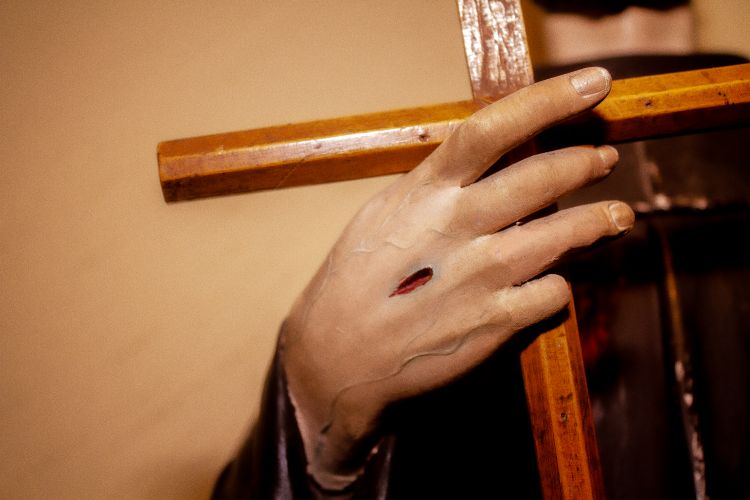
Later this week, on September 23rd, the Church celebrates the memorial of St. Padre Pio, a saint celebrated for his extraordinary spiritual gifts. St. Pio (1887-1968) was an Italian Capuchin friar known for his mysticism, healing abilities, miraculous bilocation, and the ability to read souls during confession. Perhaps the spiritual gift for which St. Pio is most revered is that of bearing the stigmata – the visible bleeding wounds of Christ’s crucifixion – that we will learn about today. Let’s explore the definition of stigmata, what they mean within the Catholic tradition, and how the Church approaches claims of stigmata, ending with a few other stigmatists who have been recognized and honored by the Church.
The word “stigmata” is a Greek word (στίγμα), meaning marks or brands. Stigmata are bodily wounds, scars, or intense pains that correspond to the wounds Christ received during his Passion and Crucifixion. These typically include the five primary wounds: the nail marks in the hands and feet, and the lance wound in the side. Some stigmatists also experience wounds or pain on the forehead, corresponding to the crown of thorns, or marks on the back and shoulders from the scourging and the carrying of the Cross.
There are two forms of stigmata – visible and invisible. Visible stigmata involve actual open wounds or scars that may physically bleed, sometimes only periodically. Invisible stigmata involve the same intense pain and suffering as external stigmata, without external marks. The stigmata in either form are considered a gift and an opportunity to participate in Christ’s sufferings rather than a mere physical phenomenon.
The souls chosen to receive the stigmata are particularly blessed and holy, though they are not a reward for personal perfection in a worldly sense. They do not receive the marks for their own sake or benefit, but because they will offer their pain and suffering as a sacrifice in union with Christ for the reparation and atonement for others. To be clear, this does not suggest that Christ’s atonement is insufficient. Rather, it is a gift from Christ to allow these individuals to share in his sufferings to atone for the sins of mankind.
This participation is linked to the Catholic understanding of redemptive suffering and the communion of saints. By grace, the sufferings of the members of Christ’s Body can be united to Christ’s one sacrifice and offered for the conversion of sinners and the relief of the souls in purgatory (CCC#618, 1505, 1521).
This is something we are all invited to participate in by offering all our daily sufferings for the Body of Christ. A stigmatist is doing the same as you and I, only on a deeper level, as his or her soul is so intensely drawn into the mystery of the Cross through the marks of the crucifixion. Although the stigmata may be regarded as an extraordinary grace, the Church teaches that neither they nor any other extraordinary grace is necessary for salvation. Fidelity to the commandments, the sacraments, and the daily carrying of one’s cross remains the ordinary path to holiness for the faithful.
The Catholic Church does not require belief in any particular instance of the stigmata. The phenomenon belongs to the category of private revelation and is not part of the deposit of faith. One may be a faithful Catholic and remain skeptical of specific claims. When the Church does investigate claims of stigmata, her primary concern is pastoral – to protect the faithful from fraud, natural phenomena, psychological suggestion, or possible diabolical origin – while also recognizing true cases where God’s activity it evident after eliminating all other causes.
Stigmata are investigated like any other instance of private revelation. Both religious and secular experts are consulted, asked to investigate, and offer their findings. In evaluating a claim of stigmata, investigators consider whether the wounds correspond to those associated with Christ’s Passion, whether they arose spontaneously, often in the context of prayer or ecstasy, rather than self-infliction or another identifiable cause, and how they behave over time and under medical care. Traditional accounts sometimes describe unusual features, such as persistence despite treatment, resistance to infection, or a pleasant fragrance, but these are neither universal nor definitive signs of authenticity. No single feature establishes a supernatural origin. The person’s life is examined for heroic virtue, humility, obedience to authority, and faithfulness to Catholic teaching. The Church also does not dismiss scientific explanations but recognizes that not every case can be explained by science. In the process of beatification and canonization, stigmata alone are never treated as definitive proof of holiness; rather, they are part of the criteria considered. Heroic virtue and miracles attributed to the person’s intercession remain the primary criteria to pursue formal sainthood.
Now, let’s look at a few stigmatists that the Catholic Church has formally recognized.
St. Paul
There is debate over whether St. Paul was the first person to receive stigmata. In his own words, he states, “I bear on my body the marks of Jesus” (Gal 6:17). The question is whether Paul was speaking literally or figuratively, simply noting the suffering he explicitly endured – imprisonment, stoning, beatings, being left adrift at sea, and deprivation of food, water and sleep, etc. However, two other notable stigmatist mystics, Servant of God Therese Neumann and Blessed Anne Catherine Emmerich, were both granted visions of earlier stigmatists which included St. Paul. For that reason, it cannot be ruled out, and it is in fact quite possible that St. Paul received the stigmata.
St. Francis of Assisi
St. Francis is the first clearly documented and widely accepted case of the stigmata in Christian history. In September 1224, while praying on Mount La Verna during a forty-day fast, Francis experienced a vision of a seraph bearing the image of the crucified Christ. Afterward, the marks of the nails appeared in his hands and feet, and a wound opened in his side. People close to Francis, including his biographer Thomas of Celano and Pope Alexander IV, confirmed the reality of these marks both during Francis’ life and after his death.
St. Catherine of Siena
In 1375, while praying before a crucifix in the Church of St. Christina in Pisa, Catherine of Siena experienced a mystical ecstasy and had a vision of the crucified Christ. She saw rays of light stream from the wounds in his hands, feet, side, and head and then, felt intense pain corresponding to the same places on her own body. Out of humility and to avoid public attention, she immediately begged the Lord to keep the marks invisible during her lifetime, and her prayer was granted. She endured the hidden sufferings of the stigmata until she died in 1380, after which the wounds became visible on her body.
Blessed Anne Catherine Emmerich
In early 1813, after serious illness had confined the Augustinian nun Anne Catherine Emmerich to bed, the stigmata appeared on her body: wounds on her hands, feet, side, and head. The wounds periodically bled, especially on Fridays and during Lent, and were examined by physicians and Church authorities. The visible stigmata drew both pilgrims and scrutiny, which was another form of suffering for her. Like St. Catherine, she also asked the Lord to remove the visible signs so that she could withdraw from public attention. The exterior marks on her hands and feet disappeared by the end of 1818. However, the pain remained, and all the wounds would continue to open each Good Friday. She endured these sufferings with patience until she died in 1824.
St. Faustina Kowalska
St. Faustina received the invisible stigmata in 1936. After her perpetual vows, during prayer, she was enveloped in rays of light. Then, she felt an intense pain in her hands, feet, and side, together with pain corresponding to the crown of thorns. These sufferings recurred on subsequent Fridays, especially during Mass, lasting only a short time but with great intensity. No exterior wounds ever appeared. She disclosed the experience only to her confessor and continued to quietly and patiently unite her hidden pains with the Passion of Jesus for the sake of sinners.
What can we learn from the stigmatists? First, they show us that holiness includes suffering. Those who have been gifted with these wounds have generally lived lives of extraordinary penance, charity, and abandonment to God’s will. Second, they remind us that suffering, when united to Christ, is never meaningless. In a culture that avoids pain and suffering, the stigmatists show us that the Cross remains the path to holiness and heaven. Third, they remind us that special graces such as stigmata are extraordinary. Most of us are called to Mass, Confession, prayer, and works of mercy. Finally, the rare phenomenon of the stigmata points us to the universal call to be configured to Christ. Most of us will never receive visible wounds, but all of us are invited to carry our cross daily and to offer our sufferings in union with him.
To receive articles and reflections like these directly to your inbox, please subscribe.
If you like what you’re reading and wish to donate to help offset ongoing web maintenance, research, and development expenses for Catholic Heart Ablaze, please click here.


Leave A Comment