
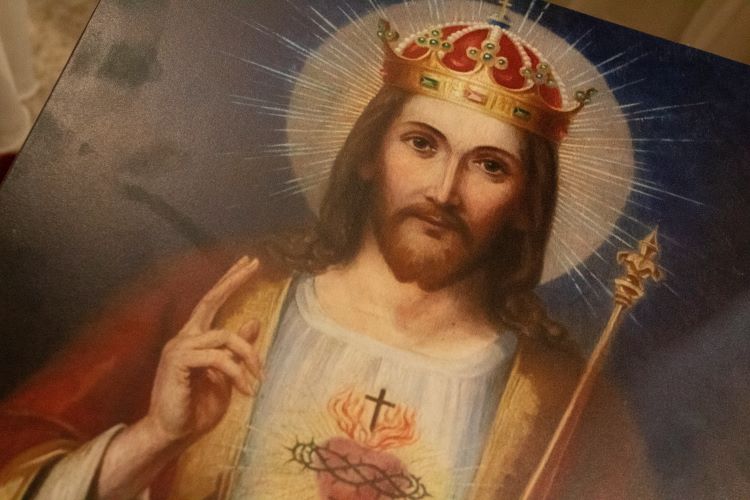
Today, on the Solemnity of Our Lord Jesus Christ, King of the Universe, it is a particularly appropriate time to reflect on the nature of Christ’s kingship and how it applies not only to our private, interior lives but also to public life and the social order. Pope Pius XI established this feast day with his 1925 encyclical Quas Primas in direct response to society’s exclusion of Jesus from both private and public life. Decades later, noting that Pope Pius’ concerns were worsening, convert to Catholicism and prolific apologist and author Michael Davies gave a talk in 1991 that was later published as a booklet in 1992. In this brief book, The Reign of Christ the King, Davies sought to reinforce the pope’s teaching that acknowledging Christ’s kingship is the answer to social disorder. We will now explore how both authors argue that the only way to find lasting peace in our lives and in the world is through the Kingdom of Christ.
Christ’s kingship rests on a twofold foundation. First, Jesus is King by natural right because he is God and our Creator. As his creatures, we are all subject to him and owe him everything. A proper understanding of the Creator–creature relationship obligates us to love and serve him. Second, Jesus is King by acquired right because he is our Redeemer, having purchased mankind with his blood. Pope Pius reminds us, “You were not redeemed with corruptible things, but with the precious blood of Christ, as of a lamb unspotted and undefiled” (QP 13, 1Pet 1:1819), and we therefore belong to Christ. Given this twofold foundation of Christ’s kingdom, his dominion extends to individuals, families, and the state. There is no separation between the private and public spheres, or at least there should not be.
Further, Christ’s kingship has a threefold power. It is legislative because he is “a law-giver, to whom obedience is due” (QP 14). It is judicial because his Father gave him the power to judge, and “In this power is included the right of rewarding and punishing all men living, for this right is inseparable from that of judging” (QP 14). Finally, Christ has executive power, “for all must obey his commands; none may escape them, nor the sanctions he has imposed” (QP 14). He exercises these three powers in the same way for the individual, the family, or the State. His authority extends to the individual, the family, and the State. Because societies are made up of individuals, salvation for all remains interconnected and requires subjection to the same King. As individuals fall deeper into disorder by disregarding the threefold powers of Christ’s kingship, so does society. Conversely, “In him is the salvation of the individual, in him is the salvation of society” (QP 18). The Catechism affirms this teaching, stating, “the Church shows forth the kingship of Christ over all creation and in particular over human societies” (CCC 2105).
Most Christians do not dispute individual submission to Christ. However, social kingship is more difficult to understand because it also makes nations and rulers subject to him. Davies illustrates this lack of proper understanding by noting that many politicians claim to be Catholic while also proclaiming that they do not allow their private beliefs to affect their public duties. The Church teaches that all legitimate authority ultimately comes from God. “Let every person be subject to the governing authorities. For there is no authority except from God, and those that exist have been instituted by God” (CCC 1899, Rom 13:1). Our governments do not give us rights and freedoms; God grants us moral freedoms. Civil law ought to align with eternal law, and God’s Commandments are binding in both public and private life. Therefore, as Davies further explains, when a public official fails to act in accordance with Christ’s laws in his public duties, he openly rebels against God. Catholic officials have an obligation to acknowledge God and support the Church’s mission in all their decisions. To do otherwise places human authority over Christ’s authority in the Kingdom of God.
Removing Christ from public life has real consequences. Society loses authentic freedom, order, and peace (cf. QP 19). Pushing our Catholic faith aside in public life leaves our authority without moral roots and liberty without truth. This results in the legalization of acts once recognized as grave injustices or contrary to God’s law. Society risks becoming dehumanized when the Creator-creature relationship is abandoned. We see offenses to the dignity of the human person everywhere today. To be clear, this is not a call for theocracy. Civil power ought to remain civil, yet it is not autonomous from the moral law or from Christ. The laity (including public officials) are responsible for ordering their temporal affairs according to God’s will (cf. CCC 898-899). The vacuum left by Christ’s absence is always filled by something else, and we make those concrete choices in our families, workplaces, laws, and culture.
How can we practically restore Christ’s social reign in the world? Pope Pius suggests we begin by submitting our minds, hearts, and wills to Christ the King (cf. QP 33). We can witness to our Catholic faith in daily life and defend the weak. We can work to order our institutions under Christ for the common good. Davies suggests re-evangelizing Catholics, restoring clear teaching on Christ’s kingship, and practicing the penance and prayer our Blessed Mother requested at Fatima. To those who say the world cannot be changed, he reminds them that people have already shaped society into what it is today. Those who knew what they wanted, even when it was contrary to God’s law, fought for it and succeeded, adding, “Shall the children of light show less zeal than the children of darkness?” Pope Pius gave us today’s feast as an annual reminder and remedy.
The Kingdom of Christ promises us peace and harmony. Davies ends on a note of hope: “Our Lady has promised that, in the end, her Immaculate Heart will triumph. She has promised this, and she will fulfill what she has promised. This means that without doubt her Son will reign – He must reign!” Pope Pius also ends by encouraging us in this work and the reward it will bring, saying:
It is Our fervent desire, Venerable Brethren, that those who are without the fold may seek after and accept the sweet yoke of Christ, and that we, who by the mercy of God are of the household of the faith, may bear that yoke, not as a burden but with joy, with love, with devotion; that having lived our lives in accordance with the laws of God’s kingdom, we may receive full measure of good fruit, and counted by Christ good and faithful servants, we may be rendered partakers of eternal bliss and glory with him in his heavenly kingdom. (QP 33)
In honor of the Solemnity of Christ the King, consider what steps you can take to build up Christ’s kingdom in both your private and public life.
To receive articles and reflections like these directly to your inbox, please subscribe.
If you like what you’re reading and wish to donate to help offset ongoing web maintenance, research, and development expenses for Catholic Heart Ablaze, please click here.

Leave A Comment