
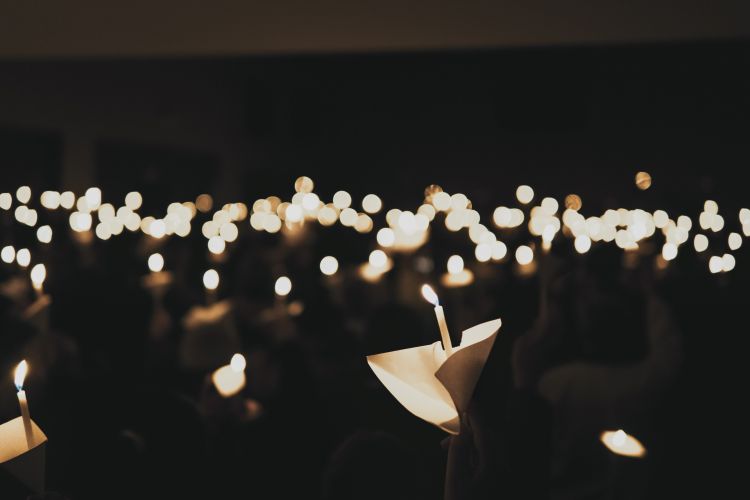
The opening ritual of the Easter Vigil Mass has profoundly meaningful symbolism. The church is darkened, representing the darkness and sadness of the Triduum and humanity’s long wait for the remedy to sin. Then, from the newly blessed fire outside, the deacon lights the Paschal candle – a tall pillar of wax – calling to mind the pillar of fire from the Old Testament, which served as a visible reminder to the Israelites of God’s presence and protection in the desert. The deacon raises it high at the church door, proclaiming, “The Light of Christ!” and we respond, “Thanks be to God!” As the flame passes from hand to hand, our own candles flicker to life, dispelling the darkness in the church. Just as light scatters darkness, Christ’s resurrection conquers the death introduced by sin, inviting us to new life. salvation
Jesus is the eternal light that has always existed since before the beginning of creation. The first words of the Gospel of John reveal to us that Jesus is the light that enters into creation and into a humanity that has been darkened by sin, a darkness that will not overcome him, prefiguring Easter’s glory.
In the beginning was the Word, and the Word was with God, and the Word was God. He was in the beginning with God. All things came to be through him, and without him nothing came to be. What came to be through him was life, and this life was the light of the human race; the light shines in the darkness, and the darkness has not overcome it. (Jn 1:1-5 emphasis added)
Just as the flame from the Paschal candle must be passed along for the light to spread and grow, there likewise must be a human response to the light that Jesus offers in the darkness of sin so that his light increases.
And this is the verdict, that the light came into the world, but people preferred darkness to light, because their works were evil. For everyone who does wicked things hates the light and does not come toward the light, so that his works might not be exposed. But whoever lives the truth comes to the light, so that his works may be clearly seen as done in God. (Jn 3:19-21)
Evil deeds prefer darkness because when they hide in the shadows, they can continue their work undetected. For Jesus’ light to be effective in our individual lives, we need to come out of the shadows and into the light, so that we might be enlightened by the truth of Christ. This underscores the importance of the Sacrament of Reconciliation, in which we actively choose to bring all our sins from darkness into light, clear the cobwebs, and allow God’s grace to radiate within us.
After the Fall, the consequences for mankind included bodily corruption and death, along with the spiritual corruption sin causes in our souls. Until Jesus came, the gates of heaven were locked to us, so humanity truly endured a period of darkness in waiting for the Messiah. However, through his Passion, Death, and Resurrection, Jesus merited for us a remedy for both our spiritual and bodily death. Spiritually, our sins can be forgiven, and we can be healed from within by the grace we receive in the sacraments. Bodily, we can look forward to our own bodily resurrection one day, as Jesus exemplified in his glorious resurrection. When he comes again, our healed souls will be restored to our glorified bodies, like his, and we will enjoy eternal life as God intended for us from the beginning. Christ’s resurrection points to a restoration of God’s original plan for us.
In each of our personal lives, we have moments and seasons of shadow and darkness. We endure trials, loss, doubt, suffering, and the effects of sin. Likewise, we are not always moving from darkness to light in a linear fashion. At times, it may feel as if we take one step forward toward the light, only to fall two steps back into darkness. If we look at our lives through the lens of salvation history, we can see that, as individuals, we are on our own Easter journey toward eternal light, just as humanity has always been. Adam and Eve went from living in paradise with God to being cast out on their own. The world was devastated by sin and destroyed, but then a new covenant was made with Noah, marked by a rainbow and a promise of no more destruction by flood. The Israelites were freed from slavery, a joyous event, only to wander in the desert for 40 years, often complaining, until the next generation finally arrived in the Promised Land. Job lost everything good in his life, however it was ultimately restored two-fold for his faithfulness. King David vacillated through periods of poverty and wealth, sin and virtue, and joy and sorrow. Through all of this, despite the setbacks, humanity’s overall momentum was moving forward toward Jesus and toward the culmination of his saving work in his Passion, Death, and Resurrection. Through our periods of darkness, we are called to remain faithful, trust in God’s plan, and keep moving forward toward the light of Christ.
Once you have experienced the hope of the Resurrection and believe in its promise, you cannot keep the light to yourself. You are obligated to share it. Notice that each time Jesus appeared to any of his disciples after he rose from the dead, they ran to share the news with others, “We have seen the Lord!” (cf Jn 20:18; 20:25; 21:7, Lk 24:33-34). They cannot contain their joy, and they must share the good news! We are called to continue to witness to the resurrection joy by our good works, justice, proclaiming the truth, charity toward others, and obedience to God’s word. That is how the light of Christ spreads throughout the world.
You are the light of the world. A city set on a mountain cannot be hidden. Nor do they light a lamp and then put it under a bushel basket; it is set on a lampstand, where it gives light to all in the house. Just so, your light must shine before others, that they may see your good deeds and glorify your heavenly Father. (Mat 5:14-16)
Easter is our holiest and most joyful feast and the high point of our liturgical year. The Resurrection of our Lord Jesus Christ is the very source of our hope. Easter proclaims the eternal triumph of light and the Resurrection’s victory over death caused by sin. In his Angelus address on November 30, 1986, Pope St. John Paul II explained that we are not oblivious to the pain and suffering of life, nor do we seek superficial joy. As Christians, we know the source of our joy. The pope said, “We are an Easter People and Alleluia is our song!” Now, we must live out this truth and spread the light of Christ into the dark places of the world so that all souls might have the same hope we are so blessed to have.
To receive articles and reflections like these directly to your inbox, please subscribe.

Leave A Comment