

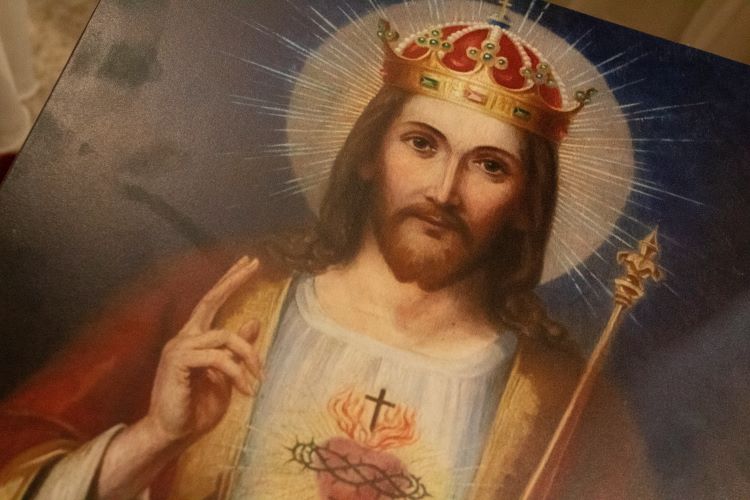
Today we celebrate the Solemnity of Our Lord Jesus Christ, King of the Universe. Of all the kings and emperors that have ruled on this earth over the millennia, none have been or will ever be as mighty and powerful as Jesus. Earthly kings rule from thrones as symbols of majesty, power, and glory. They are often ornately adorned with gold, and when the king sits on his throne, he is surrounded by his loyal subjects. The throne of Christ the King, however, is not made of beautiful, expensive, or comfortable materials, but of rough wood. The cross, which for the Roman Empire was an instrument of humiliation and torture, is the exalted throne of the crucified Lord in the light of faith. The Catechism tells us, “The way of perfection passes by way of the Cross. There is no holiness without renunciation and spiritual battle” (CCC #2015). So, through Jesus Christ, the cross is transformed from a mere place of suffering to the seat of his kingship. Let’s take a closer look at the paradox of the cross as the throne of the almighty King of the Universe.
Beginning with Scripture, Pontius Pilate asks Jesus, “Are you the King of the Jews?” (Jn 18:33). Knowing that the religious charge of blasphemy would not be enough to have Jesus sentenced to death, the Jewish leaders needed to come up with a political one. By presenting him as the King of the Jews, Jesus becomes a threat to Caesar’s authority, which is a capital offense. However, Jesus’ answer to Pilate’s question, “My kingdom is not of this world,” undermines his accusers’ charge and adds confusion to the case against him (Jn 18:36). Jesus does not deny his kingship; rather, he defines it as being radically different from worldly power.
The imagery in the Gospel of John presents the crucifixion as an enthronement. The soldiers dress him in a purple cloak — the color of royalty, place a crown of thorns on his head, and mock him, saying, “Hail, king of the Jews!” (Jn 19:2-3). The inscription placed above his head on his throne (the cross) read: “Jesus of Nazareth, the King of the Jews” (Jn 19:19). All of these actions were meant as ridicule and humiliation when in reality, through God’s providence, they were revealing truth. Jesus is a king reigning from his throne, not through domination, but through self-emptying love. “And I, when I am lifted up from the earth, will draw all men to myself” (Jn 12:32). The kingship of Christ is manifested, not in conquest or authoritarianism, but in laying down his life for his people.
The Catechism of the Catholic Church affirms the unity of Christ’s kingship with the mystery of his Passion, saying “Christ revealed his royal dignity above all in the humble service of his life and the redemptive sacrifice which won the victory over sin and death” (CCC 786). It was through the very act of sacrificing himself on the cross that his almighty power as King of the Universe was ultimately revealed. The Catechism also states, “Jesus accepted freely the Father’s plan of redeeming love. By his perfect obedience he accomplished our salvation” (CCC 606). In other words, his obedience to the point of death on a cross reveals the true measure of kingship: service, sacrifice, and self-gift. How many earthly kings over the course of history have matched, or come close to that measure of kingship?
The Gospel of Luke also provides insight into the cross as the throne of Christ the King. As Jesus hangs crucified, he is between two criminals, also being crucified. One joins the crowd in mocking him, but the other turns to him and says, “Jesus, remember me when you come into your kingdom” (Lk 23:42). What is stunning about this encounter with the Good Thief is that he perceives that the bruised and bloodied man beside him is, in fact, a king, enthroned. Christ answers him in return with royal authority, saying, “Truly, I say to you, today, you will be with me in Paradise” (Lk 23:43). As Jesus speaks as a king from his throne, the kingdom of heaven’s gate is opened for the repentant sinner, revealing Jesus’ almighty power from this seemingly humiliating and weak position.
We Catholics today have a unique opportunity to be present before the King on his throne. Every Mass is a re-presentation of Jesus’ sacrifice on Calvary. When the priest elevates the Host and Chalice, we behold the mystery of Christ reigning from the cross. The Eucharist makes present the kingly sacrifice of Christ, uniting heaven and earth. The Catechism tells us, “The Eucharist is the memorial of Christ’s Passover, that is, of the work of salvation accomplished by the life, death, and resurrection of Christ” (CCC 1409). In a sense, every altar becomes the throne of Christ the King as it becomes the place where his sacrifice is made present. There is a reason every Catholic church has (or ought to have) a crucifix hanging behind the altar. It serves as a visual reminder of what is taking place. The next time you are at Mass, allow your eyes to observe the continuity between Jesus in the Eucharist on the throne of the altar and the image of Jesus enthroned on his cross above.
If Christ reigns from the cross, then we, his subjects who were baptized into his death and resurrection, are called to share in his reign by embracing our own crosses. The cross we carry is not meaningless suffering, but rather, participation in Christ’s saving work. The Catechism teaches, “By Baptism we share in the priesthood of Christ, in his prophetic and royal mission” (CCC 1268). To reign with Christ means we ought to strive to conquer the sin in ourselves and to serve others in love — to do both of these things is to suffer. St. Paul assures us, “If we endure, we shall also reign with him” (2 Tim 2:12). Our crosses, when united to Christ’s, become thrones of grace in our own lives and the means by which we conquer selfishness, anger, and resentment and replace them with love, patience, and forgiveness.
This week, contemplate the rough wood of the cross as the throne from which Jesus reigns over the entire universe. Remember that, in his humility, he conquers all evil, and justice will be restored in due time. Think of your own crosses and imagine them as the thrones by which you are participating in the redemptive reign of Jesus rather than being mere instruments of suffering. As you contemplate Christ crucified, repeat the words of the Good Thief, “Jesus, remember me when you come into your kingdom.”
To receive articles and reflections like these directly to your inbox, please subscribe.

Leave A Comment