
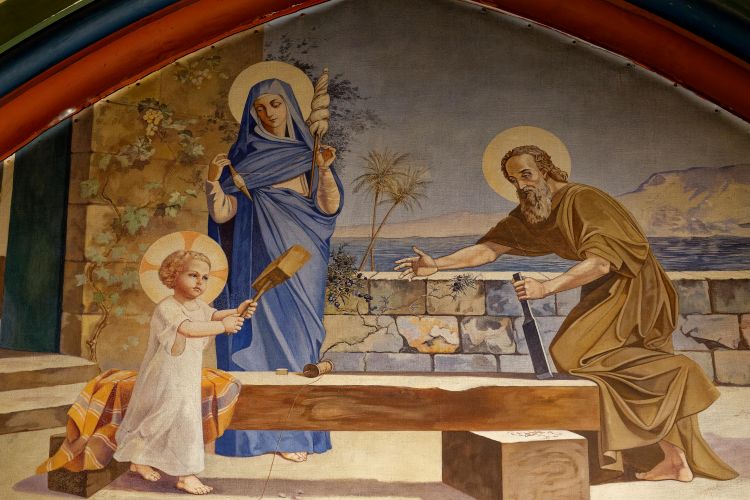
The Feast of the Holy Family is a good reminder that the family is the domestic church. Jesus learned his Jewish faith from his mother and father, Mary and Joseph. At home, he studied scripture, learned prayers, and celebrated liturgical feasts. Through his family, Jesus first learned that his Heavenly Father was loving and merciful, and that heaven was his eternal home. The Holy Family provides a perfect model of a domestic church for our own families to follow.
The Christian home is the place where children receive the first proclamation of the faith. For this reason the family home is rightly called “the domestic church,” a community of grace and prayer, a school of human virtues and of Christian charity. (CCC #1666)
Parents, call to mind the first time you held each of your children. Whether your children are biological or adopted, there was a first moment you gazed into their eyes and your heart overflowed with love. You probably had an overwhelming sense of gratitude and thanked God for the beautiful blessing he bestowed on you.
Now, call to mind the hopes and dreams you’ve had for your children from the beginning. You’ve wanted them to be happy, healthy, and successful in life and you’ve put much thought into how to instill the values and habits that will help them achieve those goals. You want to feed them the best food for their growing bodies and brains, you evaluate options for them to receive the best education, and you think about the best extracurricular activities that make them well-rounded individuals. Of course, you want to do everything you can to help each child reach his or her highest potential in every capacity!
Now, think about eternity. What do you want for your child for all time? Naturally, you want your child to live eternally in heaven and share in the divine life of the Holy Trinity. Your child has a soul, and that soul requires the same care and attention as his or her physical body in order to reach its fullest potential. You must nurture and care for your child’s soul, forming it intentionally so that it will desire to remain bound to our Lord and Savior, Jesus Christ, and will not desire anything more.
Parents, you are your children’s first and most important teachers of the Catholic faith — their primary catechists. The Catechism of the Catholic Church calls the role of evangelizing one’s children as both a “responsibility and privilege” which “precedes, accompanies, and enriches other forms of instruction of the faith” (CCC #2225-2226). In other words, rather than relying solely on priests and catechists in your parish to educate your children on matters of the faith, God has entrusted you with the primary responsibility, knowing that you are equipped with both the gifts and talents that will best lead your children into a life permeated with Christ.
It is never too early to invite children into a relationship with Jesus. You should begin in early infancy and develop your teaching in an age-appropriate manner throughout their entire childhood and into adulthood. Young babies and children, in particular, learn through all of their five senses, so it is important to use all the senses when teaching your children about Jesus and how much he loves them. Take, for example, the simple act of singing your baby to sleep. This is a very natural and normal thing for a parent to do, so why not sing Silent Night, Away in a Manger, Amazing Grace, or the Our Father while they fall asleep in your arms? Hearing Jesus’ name sung sweetly by a mother or father is a very early introduction to the way they should always sing his praises, and it helps them to associate peace, comfort, and safety with his holy name. Not only is this an excellent way for a child to begin hearing Jesus’ name, but also a way to help parents be mindful of opportunities to keep Jesus at the center of even the most mundane activities.
How often have you heard your kids (and adults!) say they don’t like attending Mass because it’s boring? Well, if they knew what was actually happening in any given liturgy, they certainly wouldn’t think it’s boring. In the liturgy, heaven and earth meet; humankind has a direct encounter with God! The apex of the Catholic liturgy is in the Sacrament of the Eucharist.
Throughout both the Old and New Testaments, Scripture is filled with examples of liturgy — the reciting of prayers, the proclamation of sacred texts, the singing of sacred music, and the offering of sacrifice and incense. We are meant to participate in formal worship in order to maintain our relationship with God. Therefore, it is imperative that your children understand what is happening in the liturgy and why, so they can fully participate. Every item that is used and everything that occurs in the liturgy has a reason, and that reason points us in some way to the mystery of the Holy Trinity. As parents, take the initiative to learn all that you can about the symbolism and realities contained in the liturgy and communicate them to your children. It is okay, and even encouraged, to point to objects around the church during Mass and explain to children what they mean.
Besides catechizing your children about the liturgy, you must take them to Mass often and to other liturgical celebrations regularly, because the liturgy will, in turn, catechize them. They will encounter Scripture profoundly, because the Mass, readings, and other liturgical rites are saturated with Scripture, both in words and actions. The prayers, homilies, and songs will teach them about the immensely numerous facets of the Paschal Mystery. By teaching your children to pay attention to the details of the liturgy, you provide them with endless opportunities to learn more and grow closer to Christ each and every time.
You have been charged with raising a child of God in the Catholic faith. This is a very important mission. You may be tempted to feel overwhelmed and discouraged, but remember what is at stake: the eternal salvation of your child’s soul! Jesus wanted so much for us to succeed in following him according to his will that he left us with the gift of the Church to guide us along the way. Perfection is not required, nor even possible. Start with one or two things you can incorporate into your child’s religious education in the home and build from there. Pray to the Holy Spirit, asking him for guidance, wisdom, and perseverance. Pray for your children always. God and the Church he established will be with you every step of the way if you are open to their guiding grace.
Chaplet of Our Lady of the Lilies for a Son or Daughter (Male Voice)
Chaplet of Our Lady of the Lilies for a Son or Daughter (Female Voice)
To receive articles and reflections like these directly to your inbox, please subscribe.


Leave A Comment