
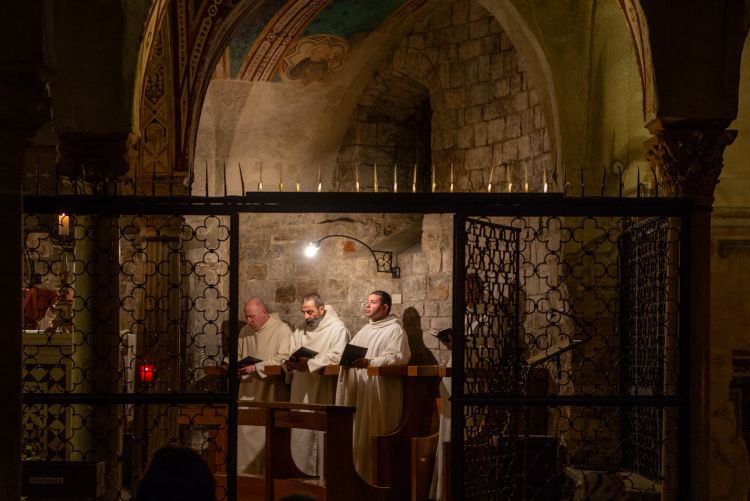
When it comes to picturing ways of serving the Church, many people likely think of priests celebrating Mass, missionary work, teaching and catechizing, or volunteers feeding the poor. These are all visible works of charity that are critical to the Church’s mission. Similarly, when we think of religious vocations, we tend to picture religious orders with which we are most familiar, given their visible activity in the world. Our diocesan priests dispense the sacraments every day, the Sisters of Charity tend to the poor and marginalized, the Fathers of Mercy come to our parishes for our Advent and Lenten missions, and so on. Again, these visibly active religious orders are a necessary and life-giving part of our Church’s mission. Still, there is another hidden type of religious community that offers a form of service just as essential to the life of the Church, even if few people ever witness it – cloistered religious orders.
Cloister comes from the Latin verb claudere, meaning “to close” or “to shut.” The noun form, claustrum, translates to “a place shut in,” or “enclosure.” In Medieval Latin, claustrum specifically referred to an enclosed area, such as a monastery or convent, that was closed off to the outside world. Depending on the religious order, there may be varying degrees of seclusion versus access to the outside world. These are determined by the order’s particular laws. Physical barriers such as walls and grilles are often utilized to help facilitate silence and undistracted prayer. Each order also follows a rule, a guide for both its individual and communal life, often written by the order’s founder. Daily life for our cloistered brothers and sisters typically includes Mass, the Liturgy of the Hours, Scripture, adoration, prayer, penitential acts, and work. A member of these religious orders does not enter into this life to escape the world, but to live a life in deep union with God.
A Dominican nun named Sr. Mary Magdalene of the Immaculate Conception Prewitt, OP, explains the essentials of what it means to go into a monastery to live a cloistered life:
A monastery is a building or collection of buildings occupied by a community of monks or nuns living under the same religious vow. Monasticism is the religious way of life, involving renouncing worldly pursuits for the sake of spiritual goods. It has evolved from the fourth century when early monastics headed out to the desert to find a secluded quiet way to live the Gospel and to follow Christ more radically.
Although they are not interacting with the outside world, these monks and nuns are still engaged in a critical activity that benefits all of us – their primary “work” of intercessory prayer for the Church, priests, sinners, the suffering, and the entire world. The Vatican’s document Verbi Sponsa explains that cloistered communities dwell “at the missionary heart of the Church” (VS #7, emphasis mine). Through constant prayer and self-sacrifice, they participate in Christ’s work of redemption, which is a source of grace for the entire world. (cf. VS #4) Think of the cloistered religious as the heartbeat of the Church, making reparations, and their prayers and sacrifices obtain graces from God for the Church and the world.
We can also think of the Church as an old steam engine. The cloisters are where the burning coals produce the steam that powers the engine. Without the prayers and sacrifices of the religious men and women behind the cloister walls, the heart of the Church is less able to pump life to the rest of the Body of Christ and its engine loses its power, and momentum.
For centuries, cloistered nuns, monks, and priests have interceded for the world in a broad sense, and they still do. However, now, due to modern technology, we, the lay faithful, may ask cloistered communities to pray for us more specifically. It is easy to find monasteries around the world online where you can submit your personal prayer intentions. (See the bottom of this page for links.) At some monasteries, Mass intentions are also accepted, and in many cases, you can have Masses offered much more quickly than you can at your local parish. Further, many of these communities support themselves by selling goods produced at their monasteries, such as coffee, beer, wine, cookies, cheese, chocolate, and other handmade items.
Although all cloistered communities, by definition, pursue holiness through “separation from the world for the sake of a complete and exclusive dedication to God in contemplation,” each order has its own unique charism and spirituality – a particular way of following Christ (VS #2) Here are some examples:
Carmelites
Perhaps the best-known contemplative order is the Discalced Carmelites, reformed by St. Teresa of Avila and St. John of the Cross during the sixteenth century. Their spirituality centers on deep interior prayer and intimate friendship with Christ. Carmelite monasteries emphasize silence, mental prayer, simplicity of life, and continual growth in union with God. St. Therese of Lisieux, a Carmelite nun and Doctor of the Church, never left her convent after entering at age fifteen. Despite her cloistered life, Pope Pius XI declared her Patroness of the Missions because her hidden life of prayer resulted in extraordinary spiritual fruit throughout the world.
Benedictines
Following the Rule of St. Benedict, written around A.D. 530, Benedictine monasteries emphasize stability, community life, hospitality, and the harmony between prayer and work – ora et labora. They pray the Divine Office every day, sanctifying their time through continual praise of God. Throughout history, Benedictine monasteries preserved Scripture, classical literature, sacred music, agriculture, education, and learning during some of Europe’s darkest centuries. Today, cloistered Benedictines continue their hidden activity through liturgical prayer and faithful community life.
Poor Clares
Founded by St. Clare and her mentor, St. Francis of Assisi in the 13th century, the Poor Clares are known for their adoption of radical poverty. Like their founders, they rely heavily on Divine Providence for their needs. Each sister has very few personal possessions. They often support themselves through crafts while their days are primarily centered on Eucharistic adoration and prayer.
Carthusians
Founded by St. Bruno in 1084, the Carthusians live a more solitary eremitical life that limits their communal interactions. Their days include silence, fasting, manual labor, and extended periods of prayer. Their motto is “Stat crux dum volvitur orbis” – “The Cross stands while the world turns.” This motto reminds us of that God never changes in a world of constant change. The Carthusian Order is considered one of the most austere cloistered and contemplative religious orders.
Trappists (Order of Cistercians of the Strict Observance)
The Trappists are a reformed version of the Cistercians and follow the Benedictine tradition. Founded in the 17th century at La Trappe, France, they practice austere silence, solitude within community, manual labor, and unceasing prayer. Trappist monks and nuns (Trappistines) live a penitential life of fasting and simplicity and are famous for producing goods such as beer and cheese to support themselves while maintaining their monasteries.
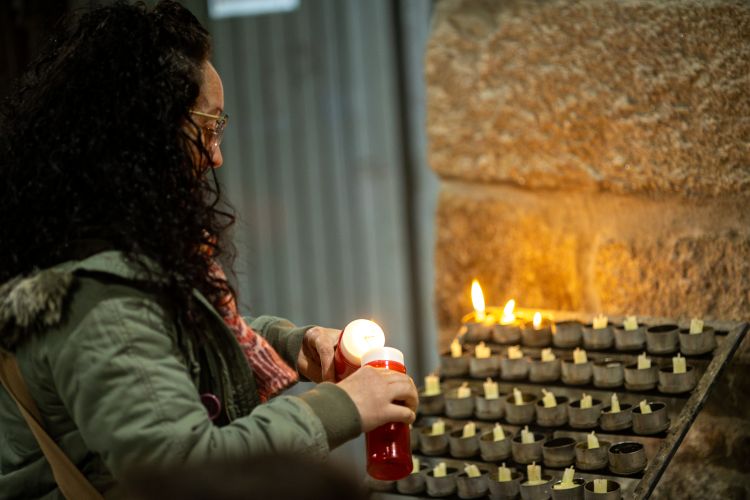
Our cloistered brothers and sisters are hidden from our sight, so they are often largely forgotten, yet it is their prayers and sacrifices that obtain many of the graces that sustain us. Because they live apart from the world, they depend on the generosity of the faithful for many of their practical needs. Purchasing monastery-made products, requesting prayers and Masses, making donations, or simply visiting monastery chapels respectfully are meaningful ways Catholics can support our cloistered friends. Most importantly, we can remember them in our own prayers. Their vocation is demanding. Their sacrifices often go unnoticed except by God, so our prayers can go a long way in sustaining them.
If you would like to investigate cloistered communities to patronize or request prayers, here are links to two directories. Each directory has a list of cloistered orders (though there are many more not listed) along with locations, descriptions, and website information:
Directory of Monasteries of Cloistered Nuns
Directory of Monasteries of Cloistered Monks
To receive articles and reflections like these directly to your inbox, please subscribe.
If you like what you’re reading and wish to donate to help offset ongoing web maintenance, research, and development expenses for Catholic Heart Ablaze, please click here.


Leave A Comment