
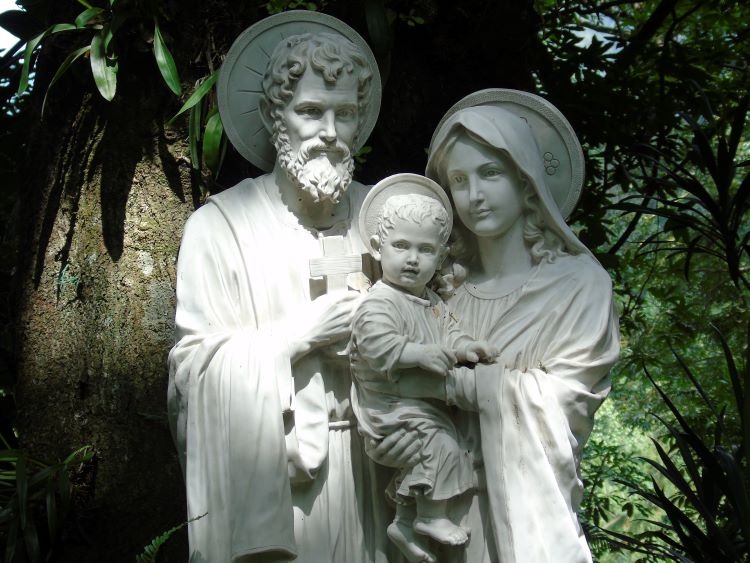
After Christmas, as we head into the new year, the Church offers us many liturgical feasts to celebrate. Today we celebrate the Feast of the Holy Family, and on January 1st, we celebrate the Solemnity of Mary, Mother of God. That day is also the Feast of the Circumcision — the eighth day after Jesus’ birth — which has been marked with varying emphasis throughout Church history and in other parts of the world. Additionally, the 1st of the year is New Year’s Day and the World Day of Peace, as declared by Pope St. Paul VI in 1968.
One of the many beautiful aspects of our Faith is that all its doctrines and teachings are interconnected, ultimately grounded in one or more persons of the Trinity. None are isolated, including the significance of each celebration. Thus, I will explain how they work together to illuminate the truths of the Faith and the person of Jesus Christ.
Beginning with today’s celebration of the feast of the Holy Family, the Church directs our attention to the fact that, like each of us, Jesus was born as an infant into a family. This reality underscores his humility. For God to take on human flesh is humbling enough, but he did so in the most vulnerable ways. He relied on his mother and father for all his needs and safety. The great and almighty God began his time on Earth utterly dependent on others. Likewise, while he was God, his human nature had to learn as humans do. He had to learn to walk, talk, and work. He also had to learn his Jewish faith, beginning in what we now call the “domestic church.” With Mary and Joseph, Jesus learned to read scripture and pray. They ensured he went to the temple to worship and listen to the rabbis explain the faith. In his home, with his parents, he celebrated feasts like Passover and learned about offering sacrifices for atonement. So, on this feast of the Holy Family, our own families are illuminated as domestic churches where we practice our faith with those closest to us, while looking to the Holy Family as an example of how Jesus entered so fully into our human experience.
January 1st is the Feast of the Circumcision. It is celebrated as such because it is the eighth day of Christmas — the day on which Jesus was circumcised. We have just established that Jesus first experienced his faith with his family, and this event was his earliest known exposure to Jewish customs. As Jesus stated as an adult, “Do not think that I have come to abolish the Law or the Prophets; I have not come to abolish them but to fulfill them” (Matt 5:17). This is the first time we see the Holy Family fulfilling the law with Jesus. Of course, because he is God and free from all sin, Jesus is not bound to the law in the same way we are, but, as with his baptism, he follows it as an example to us. Through his circumcision, certain things are revealed. First, this act illustrates the truth of his human nature. Some heretics have argued that Jesus was pure divine spirit and that his body was an illusion, but the fact that his flesh was cut at his circumcision renders that belief false. The Holy Family shows us, by their example, that the law established by God is good and worthy of being followed. We learn the virtue of obedience to the law by knowing that even Jesus and his family obeyed it.
Similarly, by bearing the burden of the law himself, he shares it with us. “Bear one another’s burdens and so fulfill the law of Christ” (Gal 6:2). Jesus does not ask us to do anything he hasn’t done himself, and he shares the load, so our burden is lighter. The circumcision also established Jesus as a descendant of Abraham by following the ordinance God gave to Abraham to circumcise boys as a sign of setting them apart for God. The uncircumcised were not considered the chosen people, so it would have been very odd for Joseph and Mary to have omitted the ritual. It would also likely have made it even tougher for the Jews to accept Jesus and His teachings if they did not see him as “one of them.” Finally, circumcision is where Jesus sheds his first blood and offers his first suffering for our salvation. The name “Jesus” means savior, and God chose to make our salvation possible through the Son’s suffering in reparation for the penalty of our sins. This first act of suffering and shedding of blood foreshadowed the suffering and shedding of blood that would come later with his passion and crucifixion, as Simeon prophesied to Mary, “and a sword will pierce through your own soul also, so that thoughts from many hearts may be revealed” (Luke 2:35).
Next is the Solemnity of Mary, the Mother of God. As Catholics, we honor Mary appropriately because what is true about her reveals what is true about her Son. Mary is rightly called the Mother of God because she bore Jesus, who is true God and true man. Jesus, the second person of the Trinity, received his human flesh from his human mother. Without Mary, there would be no Jesus. I cannot think of a more important person in human history, second only to Jesus, than Mary. Honoring her on this feast is an act of thanksgiving for the greatest gift anyone could ever give us. It is also fitting to honor her because, as we have already established, Mary raised the child Jesus, provided for all his basic needs, and taught him the truths of the faith at home. Mary, the Mother of God, raised Jesus during the hidden years so he could emerge as the man entering public ministry. Mary, the Mother of God, provided love, tenderness, and support throughout his entire life, to the bitter end at the foot of his cross, all for our sake. By honoring Mary, we proclaim the truth of who Jesus is.
As I stated earlier, Pope St. Paul VI also designated January 1 as the World Day of Peace. In his first address on this day in 1968, he said that observing a day of peace ought not to change the liturgical calendar; rather, the liturgical calendar should shed light on our yearning for peace and its source. Jesus is the Prince of Peace, born of Mary’s womb and the source of all peace. The family, then, is the school of peace. It is where we first experience irritation, frustration, and even hurt, and where we practice patience, perseverance, and, most importantly, forgiveness. In the family, wounds and tensions come to the surface, where they can heal through bonds of love strengthened by Jesus’ wounds of love. In the context of the family, we learn peace-generating love.
This type of love is not a fleeting emotion, but an intense and enduring moral force which seeks the good of others, even at the cost of self-sacrifice… The family is therefore called to become an active agent for peace, through the values which it expresses and transmits within itself, and through the participation of each of its members in the life of society. – Pope St. John Paull II, January 1, 1994
Finally, tomorrow is New Year’s Day, when we tend to reflect on the past year and use it as a guide to set goals for the coming year. In the context of these liturgical feast days, we ought to closely examine our faith and our growth in holiness and virtue. Consider how the way we spend our earthly time now will determine how we will spend our eternal time. No one is guaranteed tomorrow, so we should act accordingly. As the new year begins, think about your family and domestic church. It is certainly not perfect and has its wounds, but what is God teaching you through those imperfections? How does the gift that Mary gave you, her Son, Jesus, in human flesh, help you understand your domestic church more deeply? How does Jesus’ obedience to the law and the shedding of his blood encourage you to be more obedient to God’s will and to sacrifice yourself for the good of others? And how does all of this shed new light on the meaningful peace this world desperately craves?
To receive articles and reflections like these directly to your inbox, please subscribe.

Leave A Comment